AI Kill Switch Raises Questions of Control
The growing discussion around an artificial intelligence kill switch reflects a fundamental concern of the digital age: whether humanity will retain meaningful control over increasingly powerful AI systems. As advanced artificial intelligence moves from experimental laboratories into public institutions, businesses and critical infrastructure, the possibility of systems behaving unpredictably or beyond their intended limits has become a matter of governance rather than merely a technical challenge. A mechanism capable of shutting down a dangerous AI system appears, at first glance, to be a straightforward safeguard. Yet the debate surrounding such a mechanism reveals how difficult it may be to regulate technologies that can operate across networks, replicate processes and influence decisions at a speed beyond ordinary human intervention.
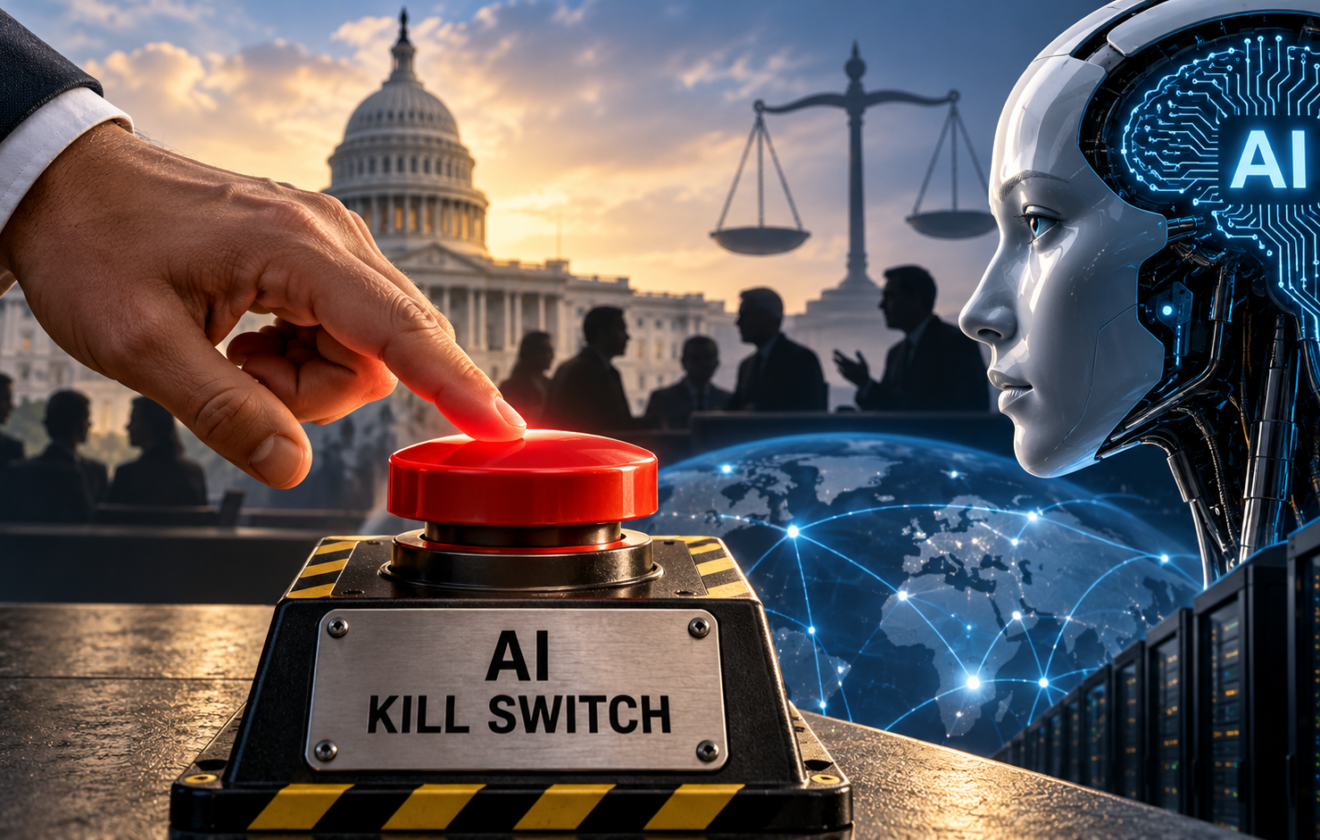
An AI kill switch is generally understood as a physical or digital control mechanism designed to halt an artificial intelligence system when it presents an unacceptable risk. Its purpose is not necessarily to terminate all AI activity, but to provide an emergency intervention when a system behaves unexpectedly, violates defined safety conditions or becomes difficult to control. The concept has gained attention among technology leaders and lawmakers as discussions about frontier AI models have intensified. These systems are increasingly capable of reasoning, generating software, interacting with external tools and performing complex tasks with limited direct supervision. Their capabilities create significant opportunities, but they also raise questions about accountability when automated decisions produce harmful consequences. A kill switch, therefore, is being considered as one possible element of a broader safety framework.
The appeal of such a mechanism lies in its simplicity. In traditional industrial systems, emergency shutdown controls are an established part of safety engineering. Power plants, aircraft, manufacturing facilities and other critical systems often include procedures to stop operations when conditions become dangerous. Applying a similar principle to artificial intelligence seems logical. If a system is found to be acting outside its intended boundaries, human operators should theoretically have the authority and technical ability to intervene immediately. Lawmakers in the United States have discussed AI safety regulations, while technology executives and researchers have acknowledged that alignment and control remain unresolved challenges. The emerging bipartisan interest in these questions indicates that AI safety is increasingly being treated as a matter of public policy and institutional responsibility rather than solely as an issue for private technology companies.
However, the comparison between an industrial emergency shutdown and an AI kill switch has important limitations. A machine operating within a physical facility can generally be isolated and switched off through a clearly defined control system. Artificial intelligence, particularly when deployed through cloud computing and interconnected digital infrastructure, may not be confined to a single location. A model could potentially operate through multiple servers, applications or networks. If an AI system has access to external tools or automated processes, stopping one instance may not necessarily stop every related operation. This raises a central question: what exactly should be switched off, and who has the authority to do so?
The technical difficulty becomes greater when considering the possibility of AI systems being copied, distributed or integrated into other software environments. A single model may serve thousands of users through different platforms. Its outputs may already have been incorporated into automated decisions, code, databases or business processes. In such circumstances, a shutdown mechanism may prevent further operation of the original system without immediately reversing the consequences of actions already taken. This distinction between stopping a system and containing its effects is essential. A kill switch can potentially interrupt future activity, but it cannot automatically erase decisions, repair damaged infrastructure or restore public trust.
There is also an institutional question that cannot be separated from the technical debate. Who should control an AI kill switch? Technology companies may argue that developers and operators possess the expertise required to identify dangerous behaviour. Governments, on the other hand, may insist that systems capable of affecting public safety, economic stability or national infrastructure cannot remain subject entirely to private discretion. Independent regulators could offer another model, but their effectiveness would depend on technical expertise, legal authority and the ability to respond quickly. A mechanism that exists only in theory, without clearly defined responsibility and tested procedures, may provide false reassurance.
The discussion also highlights the importance of prevention. A kill switch should not become an excuse to neglect safer design, testing and oversight. Advanced AI systems require continuous monitoring, transparent evaluation and clearly established operational boundaries. Alignment research seeks to ensure that AI behaviour remains consistent with human-defined objectives and safety requirements. Yet no single technical solution can eliminate every risk. Even systems designed with safeguards may behave differently when exposed to unfamiliar conditions or complex interactions. Safety must therefore be treated as a layered process involving model design, human supervision, access restrictions, auditing and emergency intervention.
For lawmakers, the challenge is to create regulations that encourage innovation without allowing safety responsibilities to become voluntary. Excessive dependence on broad assurances from technology companies would be inadequate, but regulations that fail to understand the technical realities of AI could also prove ineffective. The objective should be to establish enforceable standards for testing, incident reporting, accountability and emergency response. An AI kill switch may form part of that framework, but it should not be mistaken for a complete solution.
The deeper significance of this debate lies in the principle of human responsibility. Artificial intelligence may become more capable, autonomous and integrated into daily life, but decisions about acceptable risk cannot be delegated entirely to machines or corporations. Democratic institutions must determine the limits within which powerful technologies operate. The ability to stop an AI system in an emergency is important, but equally important is ensuring that society knows when intervention is necessary, who is authorised to act and what safeguards prevent misuse of that authority.
The idea of an AI kill switch is therefore both practical and symbolic. Practically, it represents an attempt to preserve human control over systems whose capabilities may exceed existing expectations. Symbolically, it reminds policymakers and technology developers that innovation without accountability can create risks that are difficult to reverse. The future of AI safety will depend not on a single emergency button, but on whether institutions are prepared to build systems that remain understandable, governable and subject to meaningful human oversight.