Middle East Crisis Tests Regional Stability
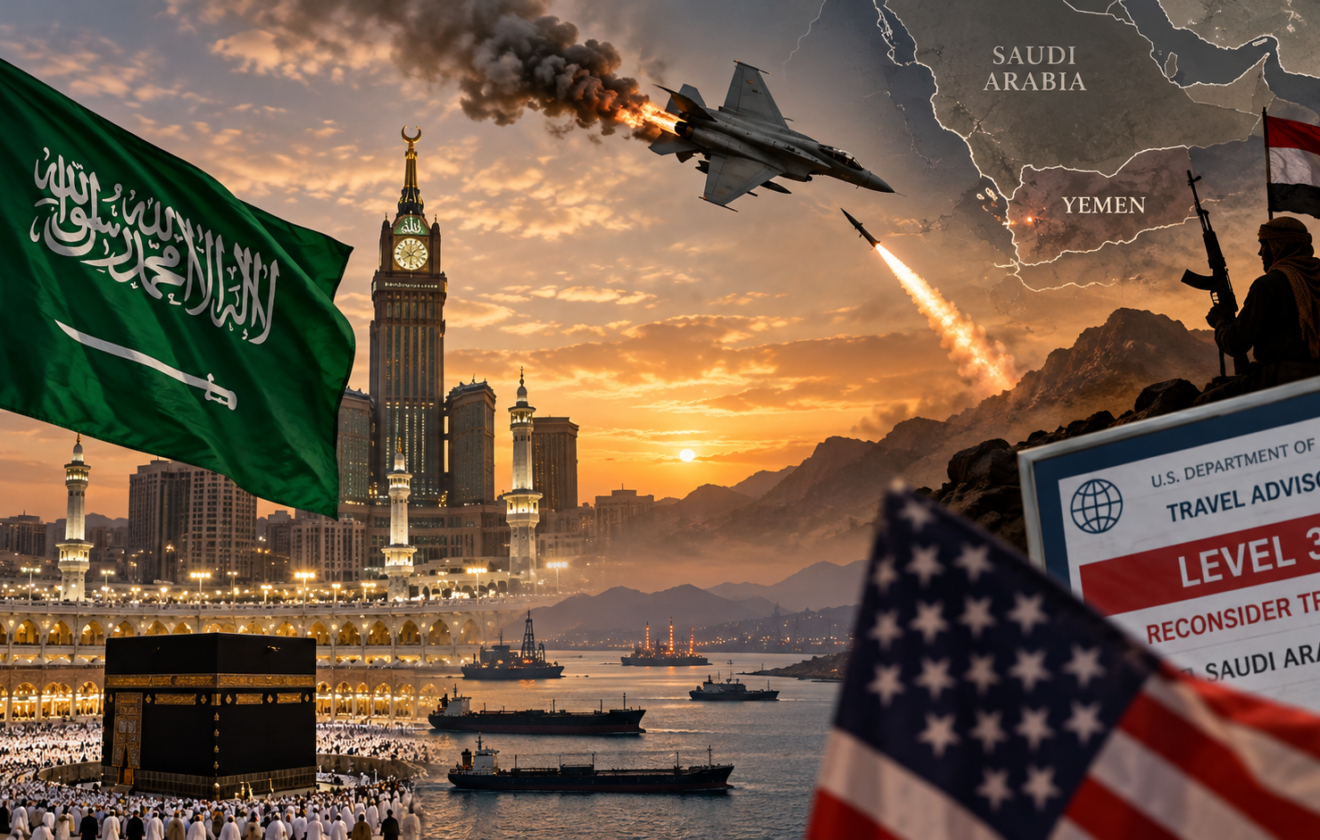
The latest escalation in the Middle East has demonstrated how quickly a conflict centred on Yemen can acquire wider regional and international consequences. The United States has retained Saudi Arabia at Level 3, “Reconsider Travel”, while maintaining a Level 4 “Do Not Travel” warning for areas along the Yemen border. The advisory reflects concerns over drone and missile attacks, armed conflict, terrorism and the risks faced by American interests and personnel.
The immediate security developments are equally significant. Saudi Arabia reported the interception of a Houthi drone near Mecca, an incident carrying particular sensitivity because of the city’s religious importance. The Houthis have denied targeting the holy city, describing the accusation as misinformation. Such conflicting accounts illustrate one of the central dangers of the present crisis: military incidents are rapidly becoming instruments of political communication, making independent verification increasingly important. When allegations involving sacred sites enter an active conflict, the possibility of escalation extends beyond conventional military calculations.
More consequential is the Houthi claim that a Saudi F-15 fighter aircraft was shot down over Marib province. Saudi authorities have not officially confirmed the loss, and independent verification remains incomplete. However, available open-source assessments indicate that the footage released by the Houthis may depict an actual aircraft crash, although questions remain regarding its authenticity and circumstances. Regardless of the final determination, the claim itself carries strategic significance. A successful interception of a modern fighter aircraft would represent a serious challenge to assumptions about air superiority and missile defence in the region. Even an unverified claim can influence military calculations, public confidence and the willingness of external powers to intervene.
The United States travel advisory should therefore not be viewed merely as routine administrative guidance. It reflects a broader recognition that the security environment surrounding Saudi Arabia has become more unpredictable. The warning includes risks to energy infrastructure, military installations and American personnel, while also highlighting possible flight disruptions caused by missile interceptions and falling debris. The Yemen border remains under the strictest warning category, with restrictions imposed on U.S. government employees travelling near the frontier. These measures indicate that the conflict is no longer confined to isolated exchanges between armed groups. Its consequences are beginning to affect diplomatic operations, commercial aviation, energy security and international mobility.
Saudi Arabia occupies a particularly important position in this crisis because of its geographic and economic significance. Its Red Sea ports and energy infrastructure connect regional security directly with global trade. Recent attacks and instability around the Bab el-Mandeb Strait and Saudi oil facilities have raised concerns over the reliability of international shipping routes and energy supplies. Reports of damage to or disruption of critical infrastructure have already contributed to heightened market uncertainty. The vulnerability of these routes demonstrates that conflicts in strategically located regions rarely remain local for long. A disruption in one corridor can influence fuel prices, shipping costs, insurance premiums and industrial supply chains across continents.
The diplomatic dimension is equally important. Saudi Arabia’s efforts to secure assistance from regional and Western partners reveal the limitations of relying exclusively on military superiority or established alliances. The United States, while continuing security cooperation and intelligence engagement, has shown reluctance to become directly involved in another expanding military front. Reports of diplomatic contacts between American officials and Houthi representatives in Oman further illustrate the complexity of Washington’s position. For Saudi Arabia, the challenge is not simply how to respond to attacks but how to prevent a defensive conflict from becoming a prolonged regional war with uncertain political and economic consequences.
The international community must recognise that the present crisis carries risks beyond the immediate battlefield. Yemen’s humanitarian suffering, the protection of maritime trade, energy security and the possibility of wider confrontation involving Iran and other regional actors are interconnected concerns. Military retaliation without a parallel diplomatic effort may provide temporary reassurance but could deepen the cycle of escalation. Equally, diplomatic engagement cannot succeed without addressing the security realities faced by states and civilians across the region. The responsibility of regional and global powers is therefore to establish mechanisms that reduce miscalculation, protect civilian infrastructure and preserve essential international waterways. The Middle East has experienced too many conflicts in which limited military objectives expanded into prolonged instability. The current escalation demands restraint, transparency and sustained diplomacy before another regional crisis becomes an international emergency.