Regulating Energy Drinks Responsibly
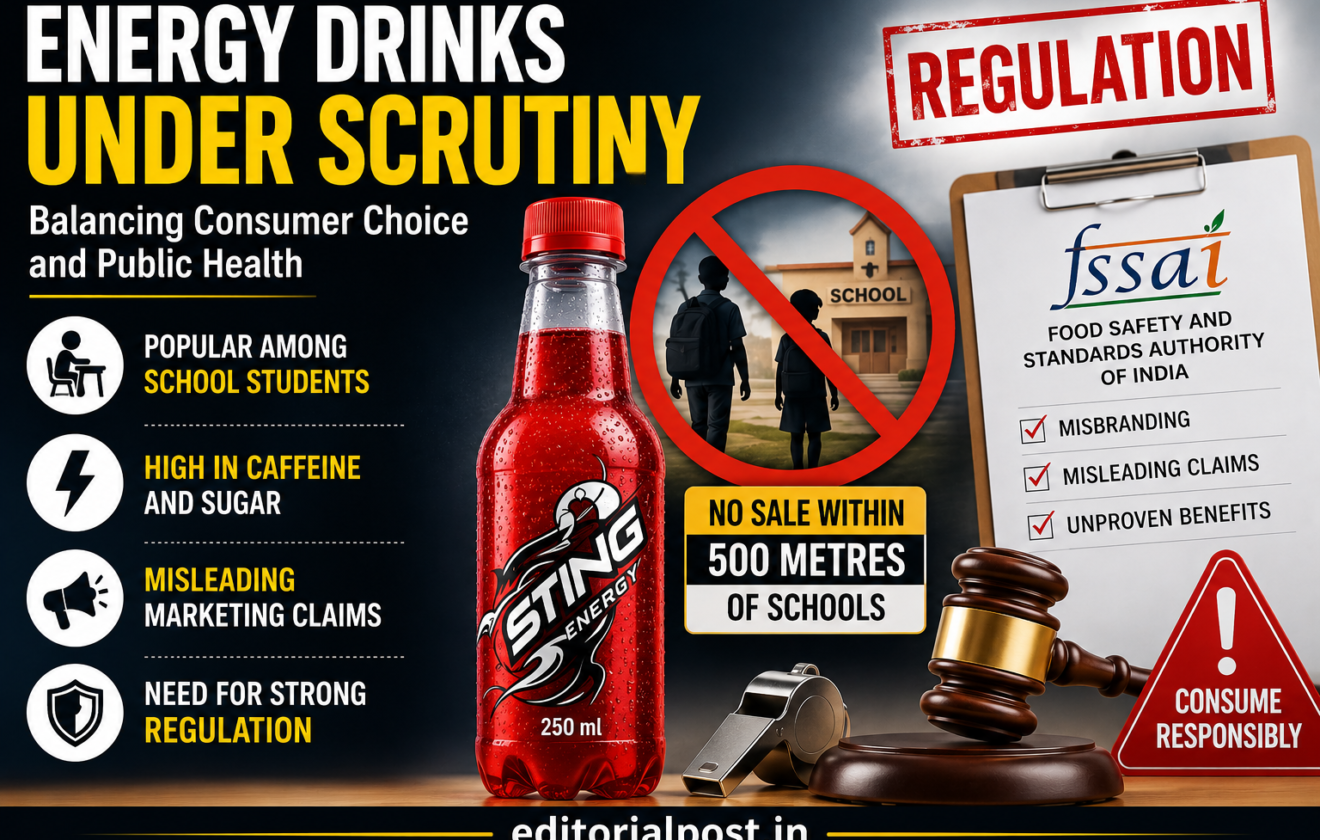
The growing scrutiny surrounding energy drinks in India is about far more than the popularity of a single brand. It raises fundamental questions about public health, consumer protection, responsible marketing, and the role of regulation in safeguarding children. The recent attention from food safety authorities and the decision to restrict the sale of certain energy drinks near schools reflect an emerging recognition that products containing significant amounts of caffeine and sugar require closer oversight, particularly when they are widely consumed by adolescents. While energy drinks remain legal products, their accessibility, marketing practices, and health claims deserve careful examination in the broader public interest.
India’s energy drink market has expanded rapidly over the past decade. Affordable pricing, attractive packaging, and aggressive marketing have transformed what was once a niche product into a mass-market beverage. Unlike premium energy drinks that appealed primarily to adults, low-cost alternatives have become easily accessible to school and college students. This shift has altered the public policy debate. The concern is no longer limited to consumer preference or business competition; it now involves the potential health implications of regular caffeine consumption among young people who may not fully understand its effects. The popularity of these products among teenagers demonstrates how pricing and marketing strategies can significantly influence consumption patterns.
The issue becomes more complex when advertising enters the equation. Energy drinks are frequently promoted using messages that imply increased alertness, improved concentration, enhanced stamina, or superior performance. Although caffeine can temporarily reduce fatigue and increase wakefulness, these effects are neither permanent nor universally beneficial. Marketing messages that simplify or exaggerate such effects risk creating unrealistic expectations, particularly among younger consumers. Regulatory authorities are therefore justified in asking manufacturers to substantiate their claims and ensure that promotional material accurately reflects scientific evidence rather than marketing ambition. Consumer confidence depends not only on product quality but also on the credibility of the information presented to the public.
The decision to restrict the sale of energy drinks within the vicinity of schools should be viewed as a preventive public health measure rather than an unnecessary commercial restriction. Schools are environments dedicated to learning, physical development, and healthy habits. They should not become convenient marketplaces for products that may encourage excessive caffeine consumption among children. Such restrictions do not prohibit adults from purchasing these beverages elsewhere, nor do they ban legitimate businesses from operating. Instead, they acknowledge that children require additional protection because their dietary choices are often influenced by affordability, peer behaviour, and persuasive advertising rather than informed judgment.
At the same time, regulation alone cannot solve the problem. Parents, teachers, healthcare professionals, and educational institutions all have a role in improving awareness about nutrition and responsible consumption. Many young consumers recognise energy drinks as fashionable beverages rather than products containing stimulants. Public education should therefore explain the role of caffeine, the effects of excessive sugar intake, and the importance of moderation. Better awareness enables consumers to make informed choices without relying solely on government intervention.
The present debate also exposes an important regulatory gap. If energy drinks occupy a distinct position between conventional soft drinks and nutritional products, then they require clear standards governing composition, labelling, advertising, and health claims. Regulatory uncertainty benefits neither consumers nor manufacturers. Businesses deserve transparent rules that establish fair competition, while consumers deserve accurate product information supported by scientific evidence. Clear standards also reduce confusion regarding what constitutes an energy drink and what claims manufacturers may legitimately make.
Industry, too, has an opportunity to respond constructively. Responsible businesses should recognise that long-term consumer trust is more valuable than short-term marketing success. Transparent ingredient disclosure, responsible advertising, prominent health warnings where appropriate, and voluntary restrictions on marketing directed at children can strengthen public confidence while reducing the need for increasingly restrictive regulation. Companies that embrace higher standards are likely to benefit from greater credibility in the marketplace.
The current controversy should therefore not be interpreted as a campaign against a particular beverage or manufacturer. Rather, it reflects the evolving expectations placed upon both regulators and industry in a society that is becoming increasingly conscious of nutrition and public health. Commercial success should not come at the expense of informed consumer choice, especially where children are concerned. A balanced regulatory framework, supported by scientific evidence and responsible corporate conduct, offers the most sustainable path forward. Protecting public health and preserving consumer freedom are not conflicting objectives; with thoughtful policymaking, they can reinforce one another.