The Rise of AI-Powered Personal Computers
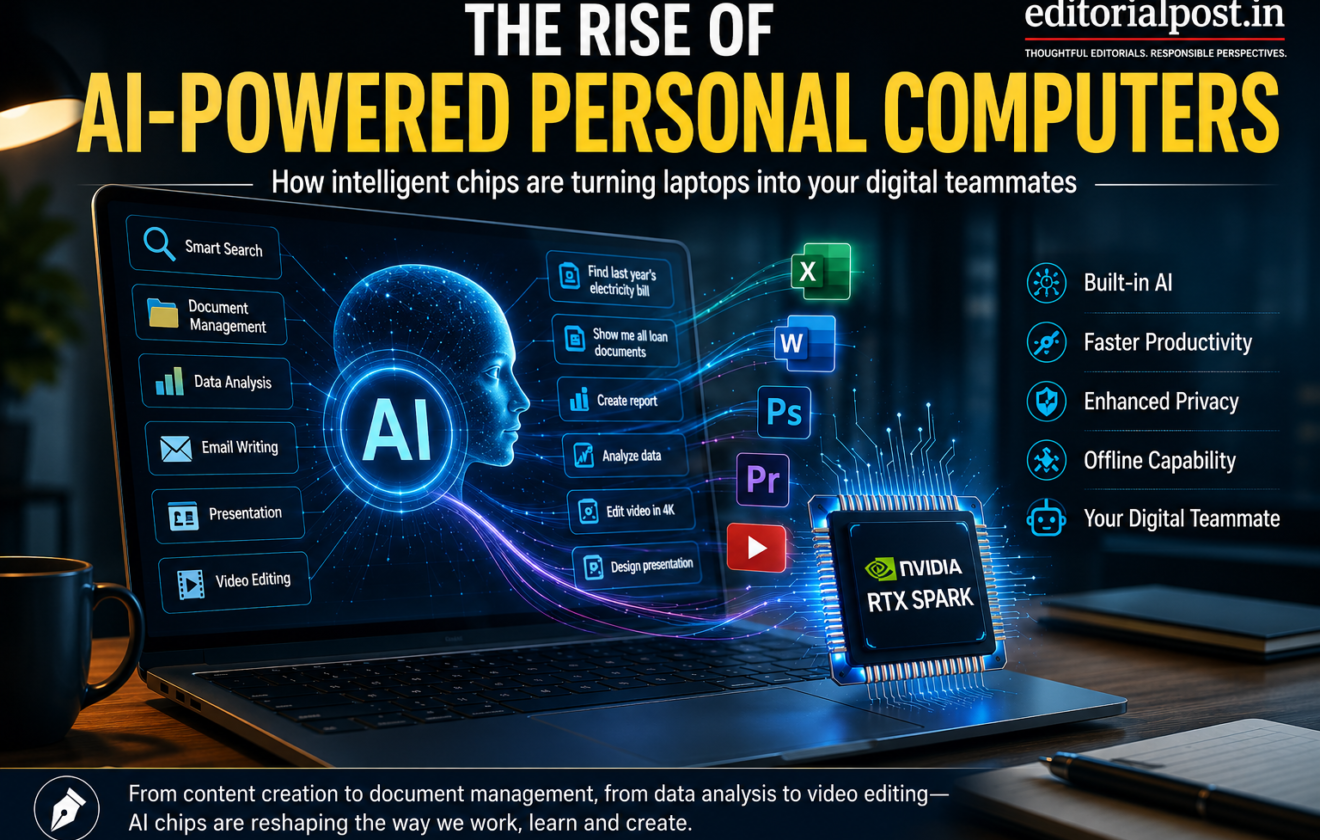
The world of technology appears to be approaching another major turning point. For decades, personal computers have served as tools that execute instructions provided by users. However, the rapid advancement of artificial intelligence is beginning to change that relationship. New generations of AI-focused computer chips are transforming laptops and desktop computers from passive devices into active digital assistants capable of understanding tasks, organising information, and supporting users in ways that were once considered futuristic.
Recent developments in the semiconductor industry suggest that artificial intelligence will soon become a built-in feature of personal computers rather than a separate application. Instead of opening multiple programs to complete different tasks, users may increasingly rely on AI systems integrated directly into their devices. Activities such as preparing reports, analysing data, managing documents, creating presentations, editing content, and drafting emails could become significantly more automated. This shift has the potential to improve productivity across industries while making advanced computing capabilities accessible to a much larger audience.
The creative sector may experience some of the most visible benefits of this transformation. Video editors, graphic designers, software developers, content creators, and digital artists often require substantial computing power to perform complex tasks. AI-enabled computers could dramatically reduce the time and effort needed for video production, visual effects, image enhancement, and software development. By bringing professional-grade capabilities to more affordable devices, these technologies may lower barriers to entry and encourage innovation among independent creators and small businesses.
Another important aspect of AI-powered computing is the possibility of performing many tasks directly on the device without constant dependence on cloud services. Local processing can improve speed, reduce internet requirements, and enhance privacy. Sensitive documents, personal records, and confidential business information may remain on the user’s device rather than being continuously transmitted to remote servers. In an era when data security has become a major public concern, this development could offer significant advantages for individuals, businesses, and governments alike.
Yet technological progress rarely arrives without challenges. History demonstrates that every major innovation strengthens certain human capabilities while weakening others. The widespread use of calculators reduced the need for mental arithmetic. GPS technology diminished reliance on traditional navigation skills. Smartphones altered attention spans, memory habits, and reading patterns. Artificial intelligence may create a similar effect. If computers begin drafting documents, analysing information, and making routine decisions on behalf of users, there is a risk that critical thinking, writing skills, and independent problem-solving abilities could gradually decline.
This raises important questions for education and workforce development. Future success will depend not only on the ability to use artificial intelligence but also on the capacity to work effectively alongside it. Schools, universities, and employers will need to place greater emphasis on uniquely human strengths such as creativity, judgement, ethical reasoning, communication, and complex decision-making. As machines become increasingly capable, these qualities may become even more valuable in distinguishing human contribution from automated processes.
The emergence of AI-powered personal computers represents more than the launch of a new category of devices. It signals a broader transformation in the way people interact with technology. Much as the internet reshaped communication and smartphones revolutionised access to information, artificial intelligence is poised to redefine how work is performed, how knowledge is managed, and how digital content is created. The true measure of this technological revolution will not be the sophistication of the machines themselves, but the extent to which society can harness their capabilities while preserving and strengthening the human skills that remain essential to progress.