AI Impact and India’s Policy Direction
Social and Policy Implications of AI
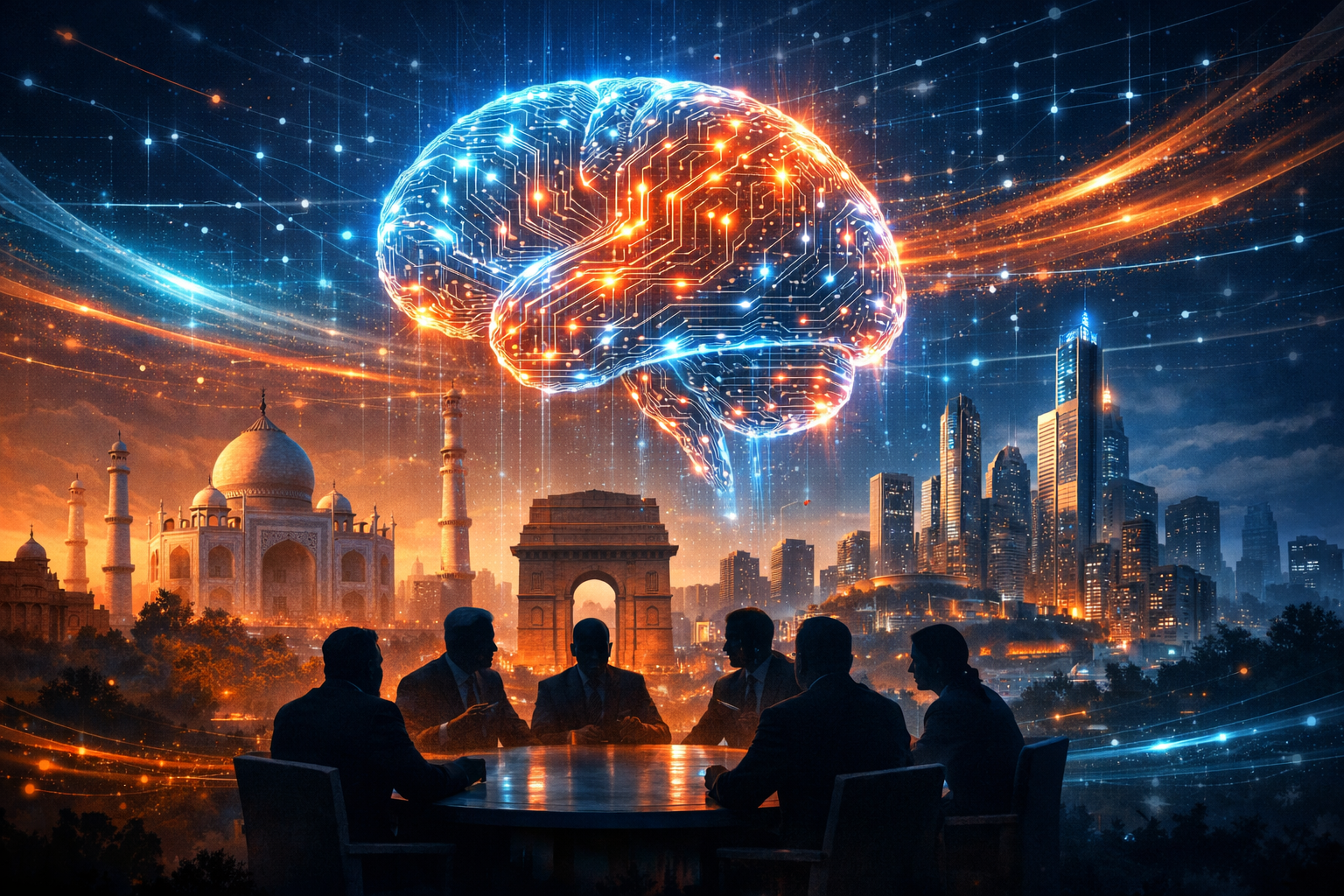
Artificial Intelligence is no longer a subject confined to laboratories or corporate innovation hubs. It has emerged as a decisive force shaping governance systems, economic structures, and social behaviour across the world. The proposed AI Impact deliberations in India represent not merely a technological gathering, but a moment of strategic reflection. When heads of state, global technology executives, and policy architects converge to discuss artificial intelligence, the underlying concern extends beyond investment opportunities. It reflects a recognition that AI is redefining power, productivity, and public systems in ways that demand coordinated thought and responsible leadership.
Globally, AI adoption is accelerating at an uneven pace. Developed economies are integrating artificial intelligence into public administration, financial systems, defence strategy, and industrial productivity with remarkable speed. Large-scale investments, advanced computing infrastructure, and research ecosystems in North America and parts of East Asia have positioned these regions at the forefront of AI-driven transformation. The global AI market is expanding rapidly, with projections indicating sustained double-digit growth over the coming decade. In such a scenario, nations that fail to build domestic capability risk strategic dependence and economic marginalisation. For India, the central question is not whether to participate in the AI revolution, but how to shape its participation in a manner aligned with national interest and long-term stability.
The rise of artificial intelligence also brings structural risks. Questions of data sovereignty, privacy protection, algorithmic bias, and cybersecurity are no longer theoretical concerns. Deepfake technologies, automated financial manipulation, digital fraud, and surveillance capacities have demonstrated that AI can destabilise institutions if regulatory frameworks remain weak or fragmented. As machine learning systems begin to influence public opinion, economic decisions, and administrative processes, the boundary between technological efficiency and democratic accountability becomes increasingly delicate. Responsible governance in the age of AI therefore requires a robust legal architecture, transparent standards, and international cooperation.
India stands at a complex intersection of opportunity and responsibility. Its vast digital population, expanding data ecosystem, and rapidly growing technology market make it an attractive environment for global AI firms. However, this scale must not reduce the country to a testing ground for external innovation. Strategic investments in domestic research, semiconductor capacity, computing infrastructure, and skilled human capital are essential if India is to transition from consumer to contributor. Public initiatives aimed at strengthening AI capability indicate awareness at the policy level, yet sustained institutional coordination between government, academia, and industry will determine whether this ambition matures into durable capacity.
The social dimension of AI transformation is equally significant. Employment patterns are evolving as automation reshapes service, manufacturing, and knowledge sectors. New skill requirements are emerging, while certain traditional roles face displacement. Without timely reskilling strategies and inclusive development policies, technological progress could intensify economic inequality. Education systems must adapt to prepare citizens not merely to use AI tools, but to understand their limitations, ethical implications, and societal impact. Social stability in the coming decades will depend on whether the benefits of artificial intelligence are distributed broadly rather than concentrated narrowly.
International AI dialogues and impact summits acquire meaning only if they extend beyond commercial optimism. They must address ethical standards, cross-border regulatory coordination, and safeguards against misuse. India has an opportunity to articulate a balanced approach that recognises innovation while safeguarding democratic values and human dignity. The debate over artificial intelligence is ultimately a debate about control, responsibility, and the architecture of future society. The AI era is advancing with certainty; the direction it takes will depend on the clarity, restraint, and foresight exercised by today’s policymakers.