Pakistan’s Strategic Choice Under Regional Pressure
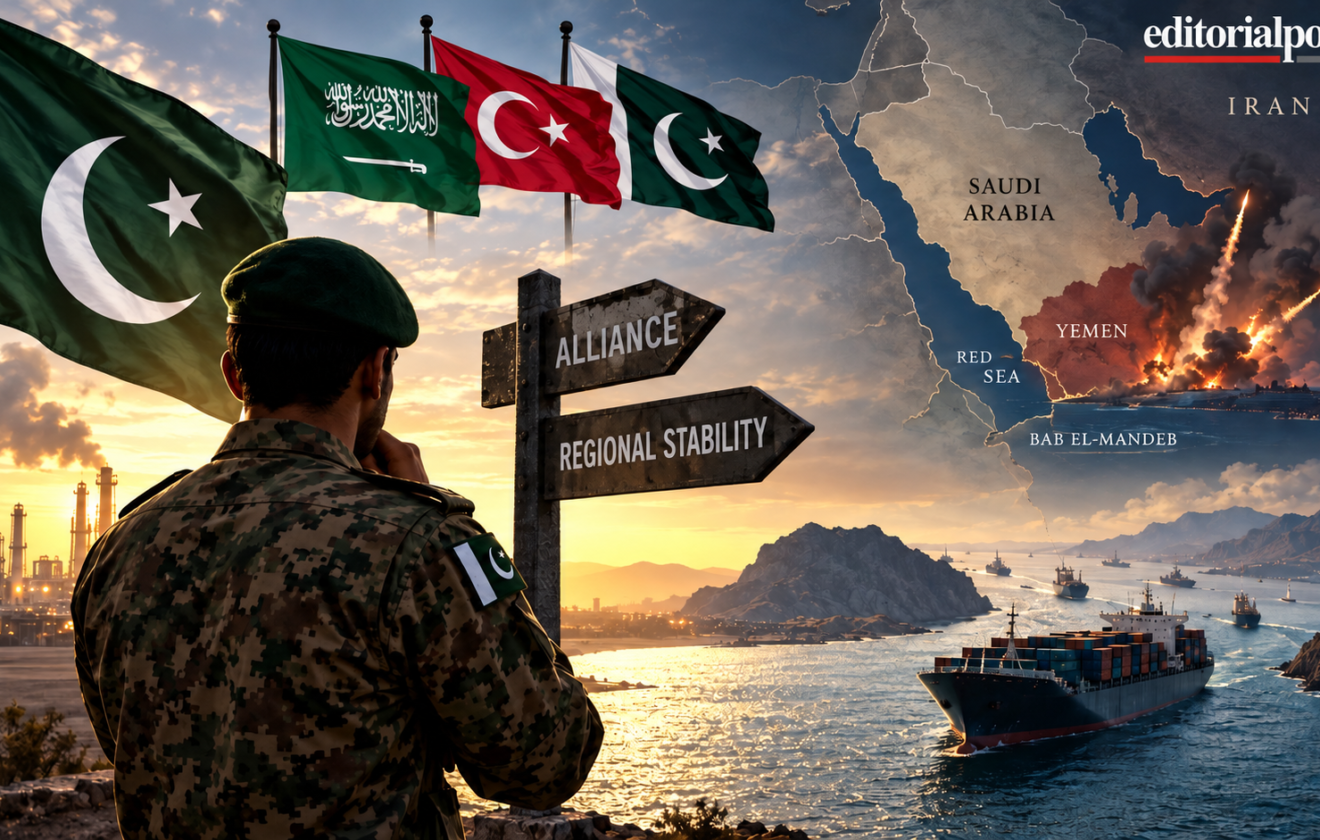
Pakistan is facing a difficult strategic choice as the conflict involving Saudi Arabia and Iran-backed Houthi forces intensifies and the security environment around the Red Sea becomes increasingly uncertain. The issue has acquired greater significance because Pakistan, Saudi Arabia and Türkiye recently entered into the Makkah Joint Defence Agreement, under which an armed attack against one member is to be regarded as an attack against all. Yet Islamabad has made clear that no military response under the agreement is currently being discussed. The contrast between the collective-security language of the pact and Pakistan’s present restraint captures the central dilemma confronting its foreign and security policy: how to remain committed to Saudi Arabia’s security without becoming directly entangled in a wider confrontation involving Iran and the broader Middle East.
The immediate pressure arises from the intensification of Houthi attacks on Saudi territory. A major wave of missile and drone attacks on 8 September reportedly struck areas including Abha, Jazan, Najran and Khamis Mushait, causing casualties and damaging or disrupting important infrastructure. Reports of fires and temporary operational suspensions at energy facilities, including the Jazan refinery, have demonstrated that the conflict can impose consequences well beyond Yemen’s borders. The attacks are particularly significant because they follow a period of relative restraint after the 2022 truce reduced the scale of direct Saudi-Houthi fighting. Their renewed intensity has therefore raised questions about whether the regional conflict is entering a more dangerous phase. For Pakistan, the timing matters. The Makkah agreement, signed on 7 August by Saudi Crown Prince Mohammed bin Salman, Turkish President Recep Tayyip Erdoğan and Prime Minister Shehbaz Sharif, was presented as a framework for strengthening collective deterrence and defence cooperation. A provision that may previously have appeared primarily strategic has now acquired an immediate practical dimension. The question is no longer simply what the agreement means in principle, but how its commitments should be interpreted if attacks on Saudi territory continue.
Pakistan’s own statements illustrate the care with which Islamabad is approaching the matter. Defence Minister Khawaja Asif has indicated that the agreement could become operational if the conflict in Yemen spills over into Saudi Arabia. The Foreign Office, however, subsequently clarified that no military response under the pact was being discussed at present while reaffirming Pakistan’s commitment to its obligations. This distinction is important because a collective-defence agreement does not necessarily imply an automatic deployment of combat forces after every attack. The nature of assistance can depend upon the circumstances, the scale of the threat and the requirements of the country under attack. It may include intelligence, logistics, ammunition, air-defence cooperation or other forms of military support without necessarily requiring immediate participation in combat. This flexibility gives Islamabad political and diplomatic space. It also reflects a practical reality: treaties establish obligations, but governments must still determine how those obligations are implemented in circumstances that may differ substantially from those envisaged when an agreement was signed. Pakistan would therefore have strong reasons to preserve room for calibrated responses rather than allowing the pact to be interpreted as an unconditional commitment to enter every regional conflict militarily.
The difficulty is intensified by Pakistan’s relationship with Iran. Saudi Arabia is a major partner for Islamabad, with longstanding defence, economic and diplomatic ties and a large Pakistani workforce in the Gulf. Saudi Arabia has also played an important role in Pakistan’s external economic relationships and regional diplomacy. Iran presents an entirely different but equally important strategic consideration. It is Pakistan’s immediate western neighbour, sharing a long border whose stability has direct implications for Pakistan’s security. Any sustained Pakistani military role against forces closely aligned with Tehran could complicate relations with Iran and create new risks along a border that Islamabad has considerable interest in keeping stable. The consequences could extend beyond conventional diplomacy. A direct Pakistani military involvement in the conflict could expose Pakistani interests, personnel and commercial links across the Gulf to retaliation or political pressure. It could also narrow Islamabad’s ability to communicate with Tehran at a time when diplomatic channels may be necessary to prevent further regional escalation. Pakistan consequently faces a balance that cannot be reduced to choosing between an ally and a neighbour. It must protect the credibility of its commitments to Saudi Arabia while preserving strategic space with Iran and avoiding participation in a conflict whose ultimate boundaries remain uncertain.
The developments along Yemen’s Red Sea coast add a wider dimension to this dilemma. The reported Houthi seizure of Mokha, situated close to the Bab el-Mandeb Strait, has increased concern about the security of one of the world’s most important maritime corridors. Bab el-Mandeb links the Red Sea with the Gulf of Aden and forms part of a major trade route connecting Europe, the Middle East and Asia. Any sustained threat to commercial shipping in this area would therefore transform a regional military confrontation into a broader international economic and maritime-security problem. The significance is greater because global shipping is already vulnerable to disruption elsewhere in the region. The Strait of Hormuz remains critical to international energy supplies, while Bab el-Mandeb is essential to shipping routes between the Indian Ocean and the Red Sea. Serious disruption at both chokepoints would have consequences extending far beyond the countries directly involved. Ships could be forced to use longer routes, increasing transport times, insurance premiums and freight costs. Energy shipments could become more expensive and uncertain, while governments and businesses would face renewed pressure from supply-chain disruption. For Pakistan, whose economy is sensitive to energy prices, freight costs and external financing pressures, a prolonged regional maritime crisis would not be an abstract geopolitical concern. It could produce direct economic consequences.
The attacks on Saudi energy infrastructure also demonstrate why the conflict cannot be viewed solely through the narrow lens of Yemen’s internal struggle. Saudi Arabia possesses major energy infrastructure whose disruption can influence international markets even when the physical damage is temporary. If attacks become more frequent or more accurate, markets may begin to price a greater risk premium into oil, shipping and insurance. The reported rise in oil prices following the September attacks reflects this sensitivity. The issue becomes more complicated if instability around the Red Sea limits the usefulness of alternative maritime routes at the same time that other regional shipping corridors remain under pressure. Energy security is consequently becoming an important component of the diplomatic calculations surrounding the conflict. Countries that may not wish to participate militarily could nevertheless be compelled to consider the economic and maritime consequences of continued instability. This is precisely why Pakistan has an interest in preventing the situation from developing into a conflict that demands military choices before diplomatic options have been exhausted.
The Makkah agreement will therefore face a test of credibility, but credibility should not be confused with automatic military intervention. For the alliance among Pakistan, Saudi Arabia and Türkiye to acquire durable strategic value, its members will need to develop mechanisms for consultation, intelligence sharing, military interoperability, logistics and coordinated decision-making. The present crisis provides an early opportunity to establish those mechanisms without prematurely converting the agreement into a framework for direct combat. Saudi Arabia may seek assistance if attacks continue, but that assistance can be calibrated according to the threat. Pakistan could potentially contribute through intelligence, defensive capabilities, logistics, training or other forms of support while retaining a clear distinction between assisting an ally and entering a broader regional war. Such an approach would neither disregard the obligations created by the agreement nor assume that every form of assistance must involve Pakistani combat forces. The strength of a collective-security arrangement ultimately depends not only on its willingness to respond, but also on the ability of its members to respond proportionately and coherently.
Islamabad’s immediate priority should therefore remain the prevention of strategic overextension. Pakistan cannot afford to treat the present crisis as a choice between absolute military commitment and complete disengagement. There is a substantial range of diplomatic and defensive options between those extremes. At the same time, ambiguity cannot continue indefinitely if attacks on Saudi territory become sustained and severe. The credibility of the Makkah agreement will depend on whether its members can define a response that is both meaningful and limited. Pakistan will have to judge carefully when assistance strengthens regional stability and when it risks making Pakistan a direct participant in a conflict beyond its core national interests. That calculation will become even harder if the Houthis consolidate their position along the Red Sea coast or deliberately expand attacks on commercial shipping. In such circumstances, the international community would face a much broader maritime-security challenge, and pressure on Pakistan to contribute could increase.
The present crisis consequently represents an early and consequential test of Pakistan’s foreign-policy balancing. Islamabad has long sought close relations with Saudi Arabia while maintaining workable ties with Iran, and that equilibrium has served important economic and security interests. The new defence arrangement with Saudi Arabia and Türkiye strengthens one side of Pakistan’s strategic partnerships but also creates obligations that cannot be ignored. Yet the responsible interpretation of those obligations must account for the wider consequences of military involvement. Pakistan’s current position—that no military response under the pact is being discussed while its commitments remain intact—provides necessary diplomatic space. That space should be used to strengthen consultation, clarify the practical meaning of collective defence and pursue measures that contain rather than widen the conflict. If the violence remains limited, Islamabad may preserve its balancing strategy. If attacks on Saudi Arabia intensify or the Bab el-Mandeb corridor becomes a sustained theatre of confrontation, however, the distinction between regional instability and direct strategic responsibility will become harder to maintain. Pakistan’s challenge will be to protect the credibility of its alliances without surrendering the strategic restraint that its own security environment requires.