Closing the Loopholes in Gutkha Ban
Despite Maharashtra’s long-standing ban on gutkha, the illegal sale and consumption of the product continue to pose a serious public health challenge. The persistence of this illicit trade has once again drawn attention following the intensified enforcement campaign led by Food and Drug Administration Commissioner Tukaram Mundhe. By directing officials to take strict action against illegal sellers and treating the trade as organised criminal activity rather than a routine regulatory offence, the administration has signalled a tougher approach. While such determination deserves recognition, the continued availability of gutkha exposes deeper legal and structural weaknesses that enforcement alone cannot overcome.
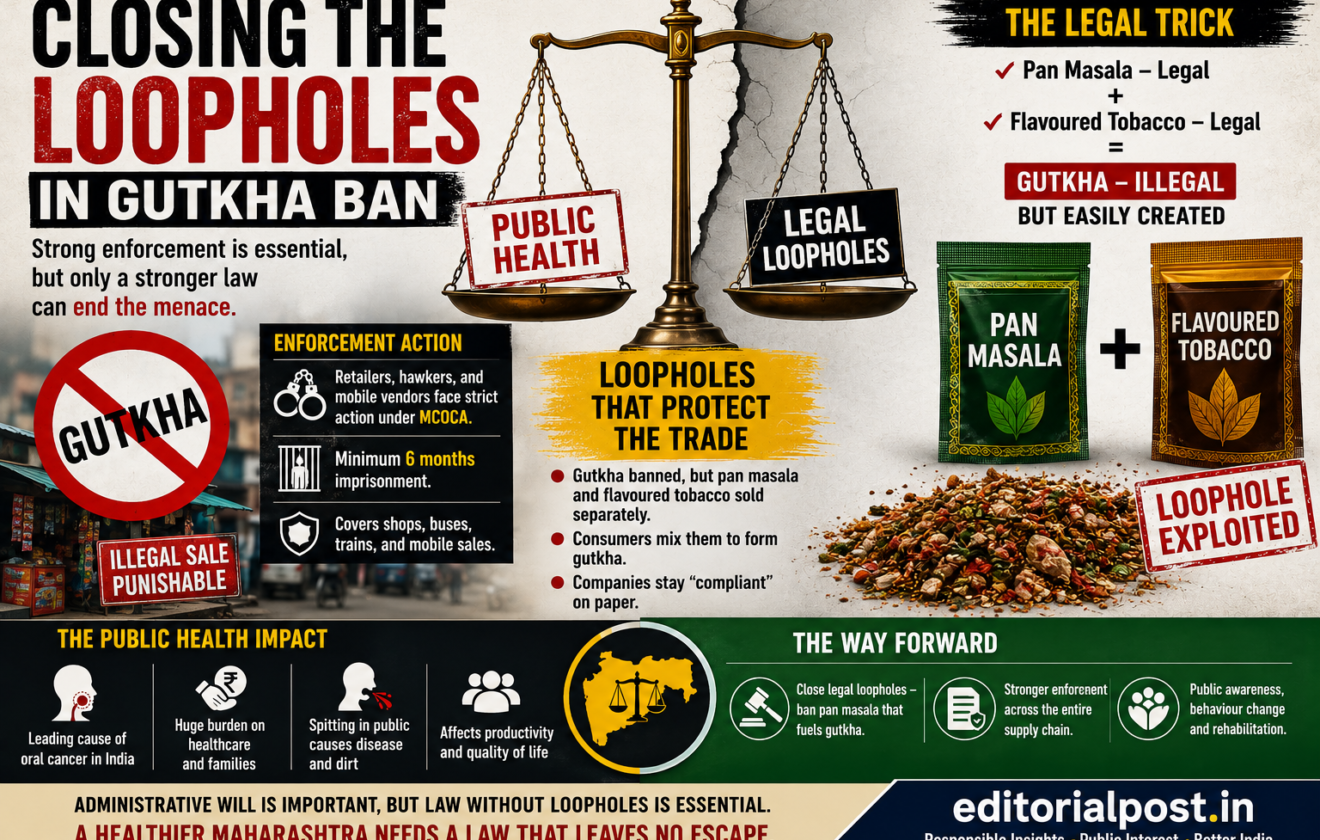
The current campaign focuses heavily on the final stage of the supply chain—the retail seller. Shopkeepers, roadside vendors and mobile hawkers found selling gutkha face severe legal consequences, including prosecution under stringent criminal provisions where applicable. The objective is clear: create sufficient deterrence to disrupt distribution at the grassroots level. Such measures may temporarily reduce street-level availability and demonstrate administrative resolve. However, concentrating enforcement primarily on retailers risks addressing only the visible end of a much larger network. As long as manufacturing and upstream distribution continue to exploit legal ambiguities, new retail channels are likely to emerge.
The central weakness lies in the legal framework itself. Maharashtra prohibited gutkha as a combined tobacco product, but manufacturers adapted their business model by separating the product into two legally distinct components—pan masala and flavoured tobacco. Individually, these products often fall within different regulatory categories, allowing companies to remain technically compliant while enabling consumers to recreate gutkha by combining the two sachets. This distinction has become one of the most significant loopholes in the state’s anti-gutkha policy. The law successfully prohibits the finished product but struggles to address the commercial practices that continue to produce the same public health outcome.
The problem extends beyond manufacturing practices to marketing strategies. Several well-known brands promote pan masala through surrogate advertising, frequently using high-profile celebrities to build brand recognition. Although these advertisements avoid directly promoting prohibited tobacco mixtures, they reinforce consumer familiarity with products closely associated with gutkha consumption. The result is a regulatory contradiction in which public messaging discourages tobacco use while commercial branding continues to normalise associated products. This weakens public health campaigns and complicates enforcement efforts.
The consequences are not limited to violations of food safety laws. Smokeless tobacco products remain among the leading causes of oral cancer in India, placing a substantial burden on families and the healthcare system. The social costs are equally significant, including reduced productivity, increased medical expenditure and widespread public nuisance caused by spitting in public places. These impacts demonstrate that gutkha is not merely a regulatory issue but a broader public health and civic challenge requiring coordinated action across multiple sectors.
The experience of other states also deserves careful consideration. Odisha has adopted a broader regulatory approach by extending restrictions beyond gutkha to include pan masala under certain regulatory measures. While every state must design policies suited to its legal framework and administrative capacity, Maharashtra may benefit from examining whether its existing legislation adequately addresses the commercial practices that have evolved since the original ban was introduced. Legislative clarity, rather than increasingly severe enforcement alone, may ultimately prove more effective in closing the loopholes that sustain the illegal market.
Administrative determination remains an essential part of the fight against gutkha, and officials committed to strict enforcement play an important role in protecting public health. Yet lasting success depends on aligning enforcement with legislation that reflects current market realities. Unless legal loopholes that permit the separate sale and marketing of complementary products are comprehensively addressed, the ban risks remaining only partially effective. A stronger legal framework, consistent regulation, responsible advertising practices and sustained public awareness together offer a more durable path towards reducing the harmful impact of smokeless tobacco in Maharashtra.