
Maharashtra’s Swayampurna Rooftop Smart Relief
Powering Homes, Cutting Bills
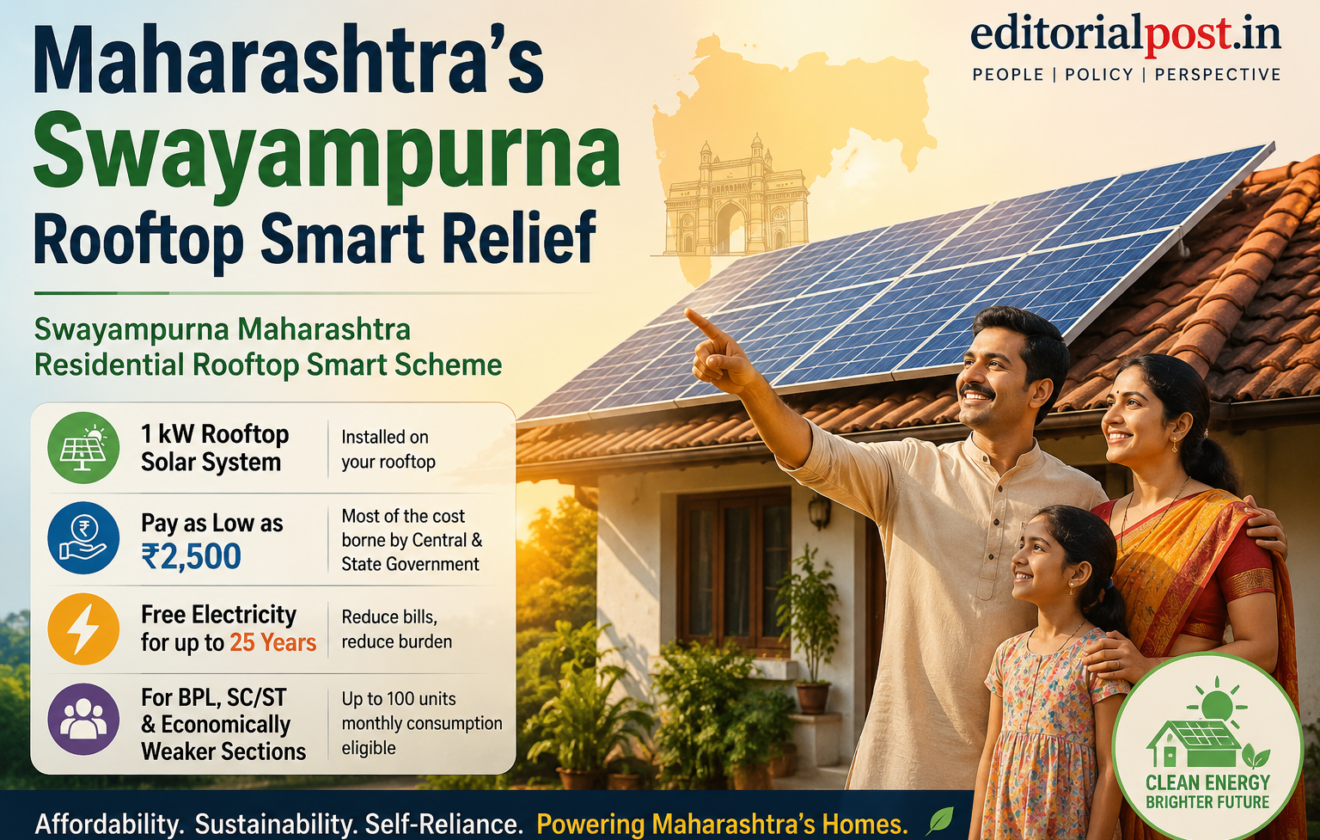
For millions of households struggling with rising electricity bills, a new rooftop solar initiative in Maharashtra has sparked attention and hope. At a time when household expenses continue to rise, access to affordable electricity has become more than a convenience; it is now a question of economic stability for many families. The proposed “Swayampurna Maharashtra Residential Rooftop Smart Scheme” seeks to reduce this burden by supporting rooftop solar installations for low-consumption households. Positioned as a step towards affordable and cleaner energy, the scheme has the potential to reshape how economically weaker families access electricity. Yet, as with every public welfare programme, its success will depend not merely on public excitement but on clarity, transparency, and effective implementation.
The scheme reportedly focuses on providing a one-kilowatt rooftop solar setup for eligible households, with a significant portion of the cost being supported by government subsidies. For families living below the poverty line and other economically weaker sections, a reduced contribution requirement could make access to solar energy possible for the first time. In practical terms, this represents more than a reduction in monthly bills. It reflects an attempt to bring energy independence closer to ordinary citizens, particularly those whose income leaves little room for unexpected expenses. However, public messaging around “free electricity” should be approached with caution. Citizens deserve a realistic understanding of what such systems can deliver, their generation limits, maintenance requirements, and the actual savings they are likely to experience over time.
Electricity affordability remains a serious concern for low-income households, especially where monthly consumption is already limited and every expense matters. In such circumstances, decentralised solar energy can provide financial relief while reducing dependence on conventional electricity supply systems. A successful rollout could lessen pressure on household budgets and offer greater energy security in both rural and urban areas. Yet access to welfare measures is often shaped by awareness and administrative ease. If eligibility rules remain complicated or information fails to reach intended beneficiaries, those most in need may once again remain outside the system. A policy designed to support vulnerable groups must therefore prioritise simplicity and accessibility at every stage.
The implementation model also deserves close scrutiny. Programmes operating on a first-come, first-served basis may unintentionally favour those who are already digitally informed or better connected to administrative systems. Families with limited internet access, weaker institutional awareness, or lower literacy levels may struggle to benefit despite being eligible. Public offices, electricity distribution agencies, and local administrations therefore carry an important responsibility to ensure that awareness campaigns are broad, application procedures are straightforward, and support mechanisms are accessible. Without such safeguards, a welfare initiative intended for inclusion risks becoming uneven in its reach.
From a wider policy perspective, encouraging rooftop solar adoption is not simply about reducing bills. It represents a gradual shift towards distributed energy production, where households contribute directly to local energy resilience. As electricity demand grows and infrastructure pressures increase, decentralised renewable energy systems could form an important part of long-term sustainability planning. However, durable success depends on quality equipment, dependable technical support, maintenance systems, and institutional accountability. Temporary enthusiasm without reliable execution often weakens trust in public programmes.
If implemented carefully, this initiative may offer more than short-term relief from rising electricity costs. It could strengthen household energy security, reduce financial stress, and encourage wider participation in clean energy adoption. Yet public welfare achieves credibility only when promises are matched by transparent delivery, equal access, and long-term reliability. In the end, affordable electricity is not merely a financial concern; it is closely linked to dignity, opportunity, and everyday economic confidence.







Excellent post. I was checking continuously this
weblog and I am impressed! Extremely useful information specially the
closing section 🙂 I care for such info much.
I used to be seeking this particular information for a very lengthy time.
Thanks and best of luck.