The Shadow of the Purge
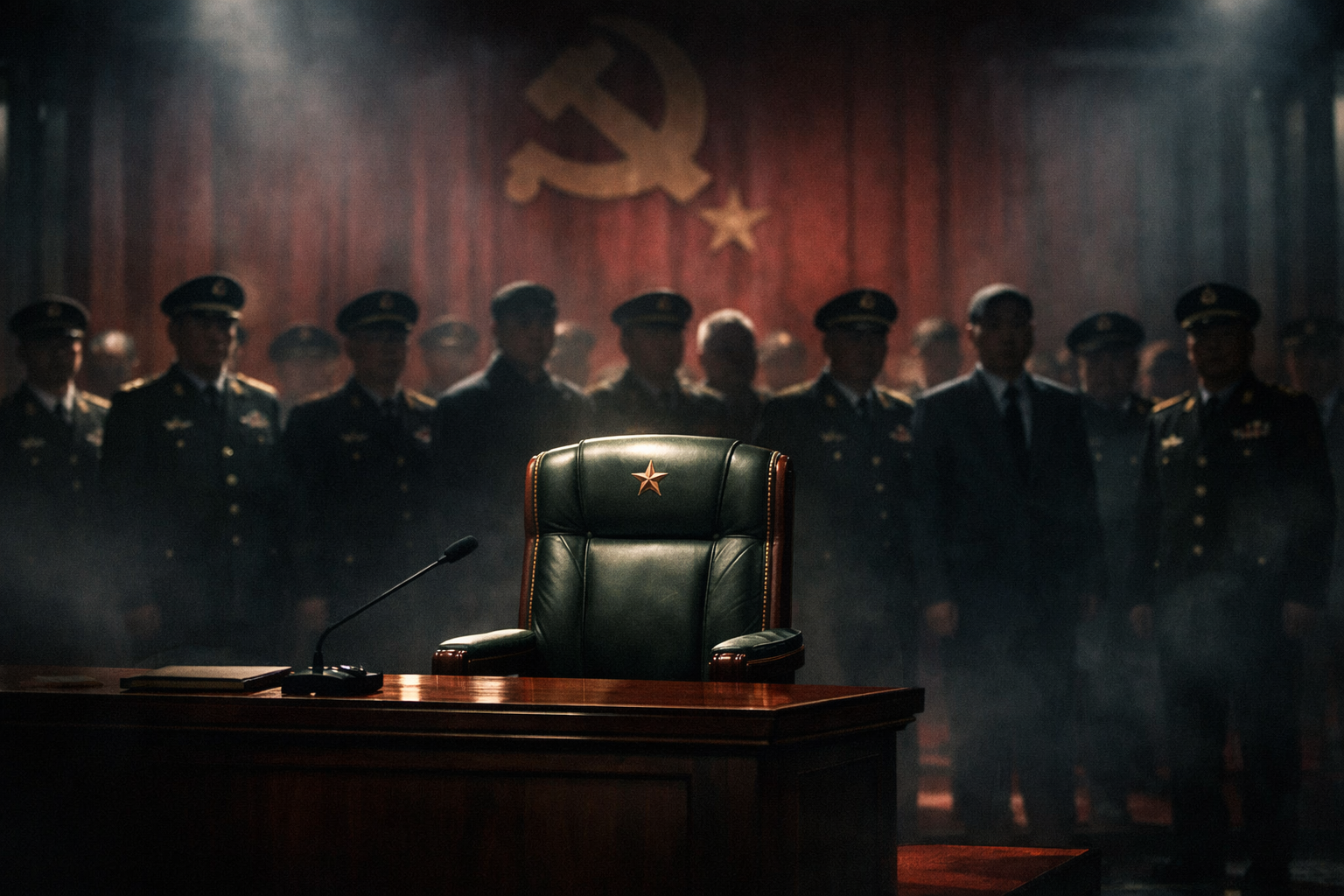
The Shadow of the Purge: Power, Autocracy, and the Fragility of Modern Democracy
The vanishing of a man like General Zhang Youxia is never a mere personnel shift; it is a tectonic fracturing of the facade of stability. For two months, the second-highest-ranking officer in the People’s Liberation Army—a “Princesling” whose lineage traces back to the 1949 revolution and a man with rare, blood-earned combat experience from the Vietnam conflicts—simply ceased to exist in the public eye. When the silence was finally broken, it was through the cold machinery of a dismissal for “discipline and law-breaking.” While the Wall Street Journal cites sources alleging the unthinkable—that Zhang accepted bribes to appoint a specific individual as Defense Minister and leaked nuclear data to the United States—the truth is secondary to the utility of the act. Zhang’s 15-year tenure and his personal proximity to Xi Jinping provided no immunity. His removal serves as a chilling reminder that in an era of absolute consolidation, personal loyalty is not a shield but a target. It is the ultimate irony of autocracy: the more power is centralized, the more insecure the center becomes, leading to a cannibalization of the very “loyalists” who built the throne.
This ritual of removal, often termed Shuddhikarana or political purification, is the essential psychological weapon of the one-party state. It is a manufactured drama designed to convince a domestic audience that the Party is a self-correcting organism, perpetually shedding its own rot to emerge “new.” By branding titans of the establishment as “foreign agents” or “corrupt,” the regime enslaves the public consciousness in a cycle of identifying and hating internal enemies. This is where the domestic “Godi Media” in India reveals its own terminal incompetence; as they perform their daily circumambulations around power in Delhi, they remain utterly incapable of reporting on the reality of Beijing because they have lost the ability to report on the reality of their own capital. They cannot explain to the Indian viewer the sibilant silence of a General’s disappearance because they are busy maintaining a similar silence regarding the erosion of accountability at home.
The underlying logic of these purges follows what can be described as “Assembly Line Production.” In this industrial metaphor for governance, officials and citizens alike are reduced to replaceable components on a factory floor. When the “owner” of the state decides that a veteran part is demanding too high a “political wage”—in the form of autonomy, institutional memory, or perceived authority—that part is discarded. Because the system is designed so that anyone can perform the repetitive task of obedience, a new, cheaper, and more compliant part is easily slotted in. This devalues the individual to the point of extinction, facilitating a regime where replacement is a preferred alternative to negotiation. It is a system that views institutional autonomy as a defect in the machinery of the line.
This volatility is a dark echo of 20th-century autocratic traditions, where the “fear of the successor” drives every decision. History shows us that the purge is most brutal when the leader feels most absolute. Mao Zedong’s Cultural Revolution did not target his enemies, but his pillars; Liu Shaoqi, his supposed successor, was purged and died in 1969, a fact kept from the nation for five years. General Peng Dehuai was broken and discarded for the sin of noticing the starvation of the people. Joseph Stalin’s purges were so thorough that the accused, like Sergei Markov in a modern Russian parallel, were conditioned to believe that their own destruction was merely a “terrible mistake” or a “misunderstanding” by the Great Leader. From Hitler’s “Night of the Long Knives,” where he executed his old comrade Ernst Röhm to neuter the paramilitary, to Saddam Hussein’s televised 1979 Ba’ath Party purge, the pattern is consistent: the removal of those who helped the leader rise is the final step in the consolidation of a regime that has entered its most fragile, paranoid phase.
This decay is not confined to the distant halls of the Kremlin or the Zhongnanhai. It has become the defining characteristic of India’s immediate neighborhood—a “neighborhood of disappearing accountability.” In Pakistan, the “general-over-prime minister” dynamic has reached such a state of maturity that the civilian leadership functions as a mere pawn, while former leaders like Imran Khan languish in a silence that barely registers on the international stage. Bangladesh experiences transitions orchestrated by military-backed expertise and reported American interference, while Myanmar remains locked in an overt military stranglehold. Across these borders, transparency has been replaced by a strategic opacity. This regional environment serves as a mirror, reflecting the quiet expiration of democratic health and the rise of systems where the public is a spectator to the maneuvers of a secretive elite.
The domestic reflection of this trend in India is increasingly impossible to ignore, as the “purge” begins to reach maturity in our own institutions. We see it in the “Assembly Line” treatment of the political class, where a figure like Mahendrajeet Singh Malviya can announce a return to the opposition only to face Anti-Corruption Bureau raids on his properties within a mere 48 hours. This is not the measured pace of justice; it is the swift, punitive strike of a system demanding conformity. The erosion of transparency is further evidenced by the opaque shuffling of ministers—such as Kiren Rijiju’s abrupt move from the Law Ministry to Earth Sciences—without a shred of public explanation. Most damning, however, is the assault on the sanctity of the vote itself. The Ejaz Ashraf report on the Odisha elections reveals a crisis of data that should haunt any democracy: substantial discrepancies between Form 17 (votes polled) and Form 20 (votes counted). In some booths, such as in Talsara, over 1,400 votes were cast, yet the official count recorded zero. In dozens of other booths, hundreds of votes simply vanished between the polling station and the counting hall. When the Election Commission meets these discrepancies with silence, and when the judiciary is perceived to be under such pressure that bail becomes a rarity and judges are transferred after ruling against the powerful, the “party-line” becomes a noose.
The final evolution of this process is the “death” of the citizen. As society is restructured to function as a singular “party,” the independent individual is replaced by a replaceable worker on the political assembly line. The ability to exit or reform the system is being systematically stripped away. The metaphor of the “iron doors” captures this finality. While democratic institutions once had “wooden doors”—flexible, perhaps creaky, but capable of being opened or exited—the modern autocrat installs doors of unyielding iron. They are heavy, permanent, and designed to bar the way. As the public is relegated to a role of passive, “Zomato-style” consumption of state narratives, the doors of dissent are being welded shut. We are witnessing the transition from a vibrant, albeit messy, democracy to a rigid, non-transparent machine where the citizen is no longer a participant, but a spare part in a mechanism designed for their own marginalization.