The Wandering Penguin of Antarctica
The Penguin That Walked Away
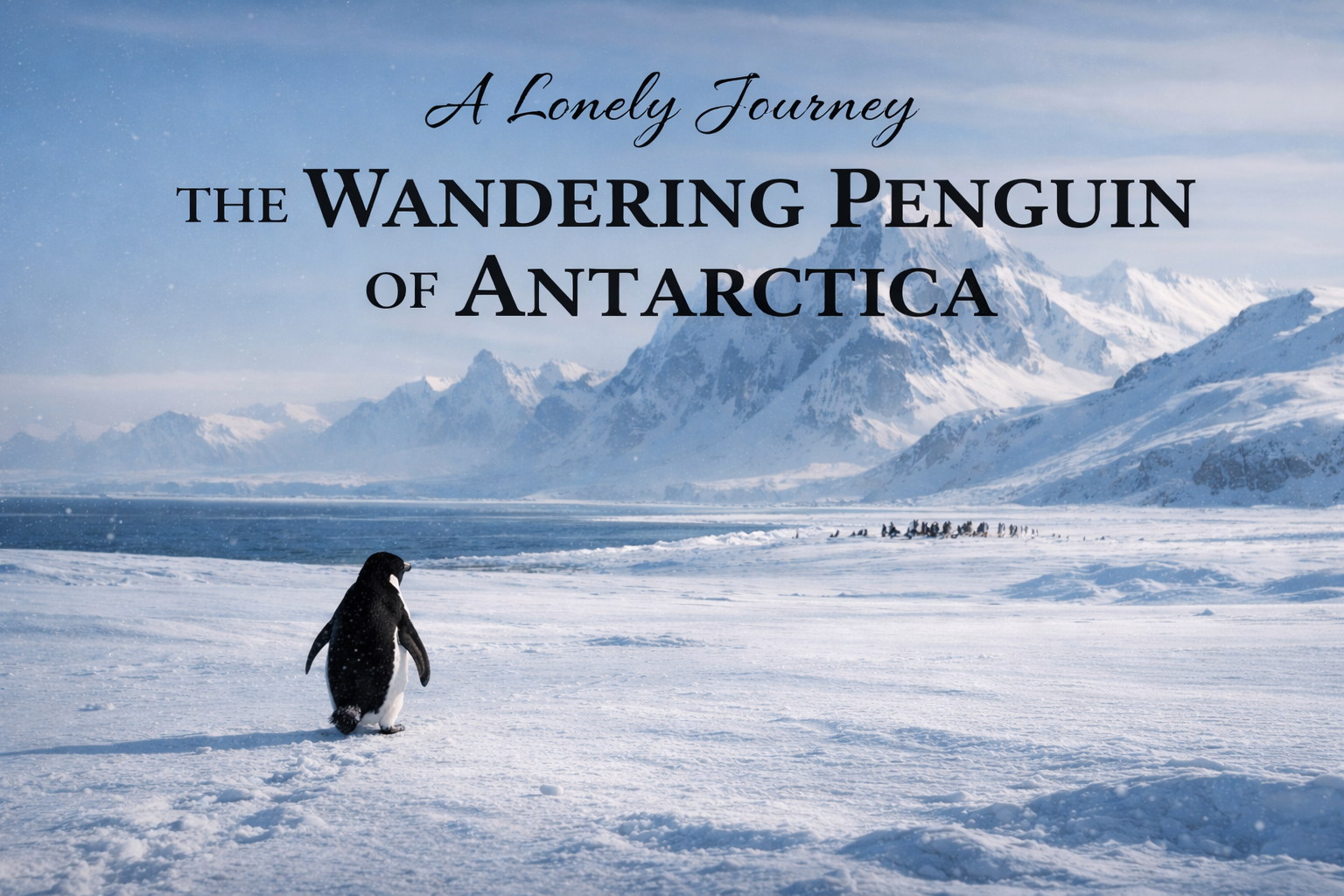
A short video circulating widely on social media shows a lone penguin separating from its colony and walking towards the distant Antarctic mountains instead of the sea. The image is stark and unsettling: an expanse of white, a small black figure, and a direction that appears to lead nowhere. Many viewers have interpreted the scene through a human lens. Some describe it as a metaphor for depression, others as an act of rebellion or existential choice. Yet the footage is not a spontaneous recording of a mysterious moment. It comes from the 2007 documentary Encounters at the End of the World, directed by Werner Herzog. What was originally captured as part of a broader exploration of Antarctica has, years later, become a digital parable.
Antarctica is among the harshest environments on Earth. Temperatures plunge to extremes, winds cut across the ice with relentless force, and the interior offers little prospect of survival for most forms of life. Penguins endure here not because the land is hospitable, but because evolution has equipped them to survive within narrow margins. Thick layers of fat, densely packed feathers, and collective behaviour allow them to withstand the cold. Their lives are organised around the sea, which provides food, and the ice, which offers relative safety from land predators. Survival depends on rhythm, coordination, and orientation.
Against this background, a penguin walking away from the sea appears irrational. The sea is sustenance. The interior, especially the mountainous interior, offers no food and no obvious refuge. It is therefore understandable that viewers, unfamiliar with the ecological realities of the region, seek meaning beyond biology. In the age of instant commentary, a powerful visual rarely remains confined to its scientific context. It becomes a canvas for projection.
However, animal behaviour does not require human psychology to be explained. Penguins rely on a range of navigational cues to orient themselves. They are known to sense the Earth’s magnetic field and to use the position of the sun and other environmental signals to guide their movements. Fatigue, illness, neurological disturbance, or simple error can disrupt these mechanisms. In extreme climates, small deviations may produce dramatic outcomes. A single bird misreading its internal compass could appear to be making a conscious choice when, in fact, it is experiencing disorientation.
There is also the broader context of stress. Breeding seasons demand immense physical sacrifice. Some penguin species travel long distances inland to reproduce, fasting for extended periods while incubating eggs. Energy reserves are depleted, and environmental pressures are constant. Under such strain, anomalies in behaviour are not impossible. To attribute such a deviation to a human-like emotional crisis risks overlooking the biological realities that govern animal life.
The popularity of the clip reveals more about contemporary media culture than about penguins. Digital platforms favour stories that evoke empathy and symbolism. A solitary figure walking away from its community resonates deeply in a time marked by discussions of isolation and mental health. Viewers instinctively recognise the image as allegorical. Yet while empathy towards animals reflects moral progress, excessive anthropomorphism can blur understanding. When every unusual act in nature is reframed as a mirror of human suffering, scientific nuance is displaced by narrative convenience.
There is a delicate balance between compassion and projection. Science increasingly recognises that many animals experience forms of stress, attachment, and behavioural complexity. Acknowledging this does not require equating animal experience with human emotional frameworks. The internal life of a penguin, shaped by instinct and adaptation, differs fundamentally from the layered social consciousness of a person. Respect for wildlife involves observing without distortion, not reshaping behaviour into familiar psychological categories.
The documentary context also matters. Filmmakers and researchers operating in Antarctica adhere to strict principles of non-interference. Observing without altering the course of events is central to preserving ecological integrity. The decision not to intervene, even when an outcome appears bleak, reflects this ethic. Nature proceeds according to its own systems. Human intervention, unless essential for conservation or research, can introduce unintended consequences. The solitary penguin’s fate, though emotionally troubling, belongs within that framework.
The enduring power of the clip lies in its simplicity. A lone creature against an immense landscape invites reflection. It prompts questions about belonging, direction, and vulnerability. Such reflections are natural and even valuable. Yet the challenge is to distinguish metaphor from explanation. The image may symbolise isolation for viewers, but that symbolism does not define the biological event itself.
In an era where fragments of documentary footage are detached from their original context and circulated globally, responsible interpretation becomes essential. Viewers must resist the temptation to reduce complex natural behaviour to simplified emotional narratives. Media literacy requires recognising when a compelling story is being constructed around a limited visual record.
The penguin that walked away reminds us not only of the fragility of life in extreme environments, but also of the fragility of meaning in the digital age. Images travel faster than context. Emotion often outruns explanation. To respond thoughtfully is not to suppress empathy, but to anchor it in understanding. Nature deserves attention that is both humane and informed.