Night Traffic and the Threat to Vision
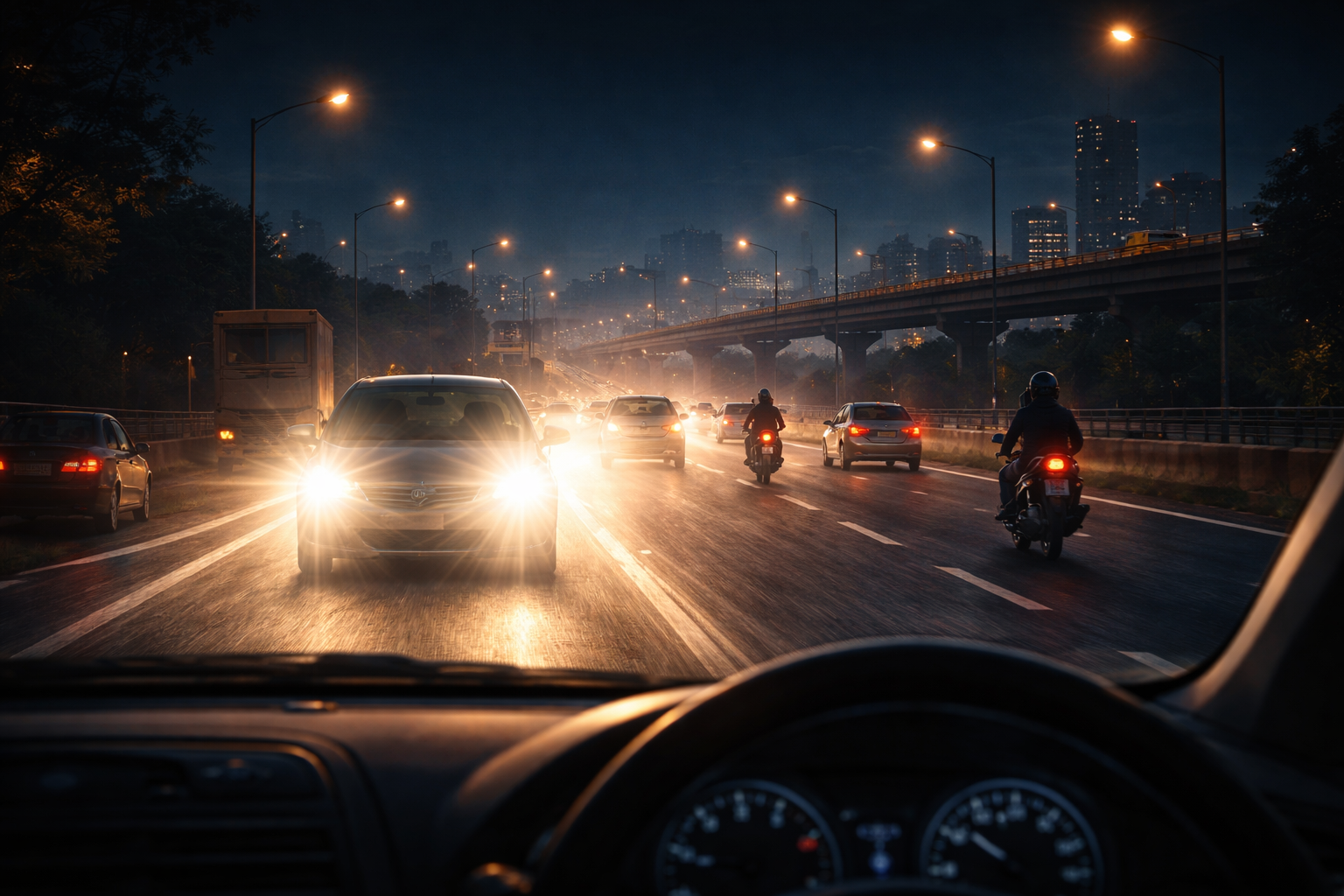
Road safety in India is often discussed through the familiar lenses of speeding, drunk driving, poor infrastructure, and enforcement gaps. Yet, an increasingly significant risk has entered the nightly traffic environment with little serious policy attention: the growing visual hazard posed by excessive and poorly regulated vehicle headlights. What was once an occasional inconvenience has now become a routine danger on urban roads and national highways alike. The glare from high-intensity headlights is no longer merely a matter of driver discomfort; it has evolved into a systemic threat to public safety that demands regulatory, administrative, and behavioural correction.
Human vision is not designed to cope with sudden, intense bursts of light in low-visibility conditions. At night, the eye naturally adapts by widening the pupil to allow more light in. When exposed abruptly to powerful headlights, particularly those emitting high levels of blue light, this adaptation becomes a liability rather than an advantage. Vision is momentarily impaired, depth perception weakens, and reaction time slows. In traffic conditions that already require heightened alertness, even a brief loss of visual clarity can prove dangerous. The increasing dominance of LED headlights, combined with indiscriminate use of high beams, has magnified this biological limitation into a widespread safety concern.
The problem is exacerbated by driving behaviour that reflects weak enforcement and low civic responsibility. High beam usage, often habitual rather than necessary, has become the norm even on well-lit city roads. In many cases, vehicles are fitted with aftermarket or overpowered lights that exceed prescribed standards, turning roads into zones of visual aggression. While regulations governing headlight intensity and beam usage do exist, their enforcement remains inconsistent. Penalties, where applied, are sporadic and rarely sufficient to act as deterrents. This regulatory gap has allowed unsafe practices to become socially acceptable, with little regard for their collective consequences.
The impact of headlight glare is not evenly distributed. Elderly drivers, individuals with early vision impairments, professional drivers undertaking long night shifts, and two-wheeler users are particularly vulnerable. For many, night driving becomes a source of anxiety rather than mobility, leading some to avoid it altogether. This has implications beyond safety, affecting livelihoods, access to essential services, and overall quality of life. When public transport drivers and freight operators are affected, the risk extends to passengers and supply chains, reinforcing the idea that this is not an individual inconvenience but a public issue with economic and social dimensions.
From a policy perspective, the persistence of this hazard reflects a reactive rather than preventive approach to road safety. Post-accident responses dominate administrative attention, while everyday risks such as visual impairment from glare remain under-addressed. Clearer standards on permissible headlight intensity, stricter controls on vehicle modifications, and routine compliance checks must become integral to traffic governance. Technological progress in the automobile sector should be guided by safety compatibility, ensuring that innovation does not outpace regulation. The objective should be functional illumination, not visual dominance on the road.
Public awareness must complement regulation. Responsible beam usage is as much a matter of driving ethics as it is of legal compliance. Driver training programmes should emphasise night-time visual limitations and the dangers posed by unnecessary glare. Licensing systems and refresher courses offer opportunities to reinforce these principles. Road safety campaigns, often focused narrowly on speed and helmets, need to broaden their scope to include visual safety as a core concern. Without behavioural change, enforcement alone will remain insufficient.
The issue of night-time glare highlights a broader truth about infrastructure and technology: progress that ignores human limits undermines its own purpose. Roads are shared spaces, and visibility is a collective resource rather than an individual privilege. Headlights are meant to illuminate the path ahead, not to blind those approaching from the opposite direction. Treating visual safety as a marginal concern risks normalising a preventable danger. Addressing it decisively would not only reduce accidents but also restore a sense of mutual responsibility on the road, making night travel safer, calmer, and more humane.