Budget 2026 and the Discipline of Direction
The Union Budget 2026 arrives at a moment when India’s macroeconomic confidence is relatively firm but the pressures of scale, aspiration, and global uncertainty remain unresolved. It is a budget that resists dramatic announcements and instead seeks to consolidate a particular governing philosophy: growth anchored in public investment, fiscal discipline maintained through calibrated restraint, and structural reform pursued without overt populism. In doing so, it reflects continuity rather than disruption, signalling that the state views the coming decade less as a period of crisis management and more as one of institutional consolidation. The emphasis on capital expenditure, tax simplification, and sectoral productivity points to an intent to shape long-term capacity rather than deliver short-term political relief, a choice that carries both promise and risk.
At the centre of the budget lies its fiscal posture. By committing to a gradual reduction of the fiscal deficit while simultaneously expanding capital expenditure, the government has reaffirmed its belief that credibility in public finance is itself a growth instrument. The steady narrowing of the deficit, combined with an explicit medium-term debt trajectory, suggests an awareness that India’s growth story must be protected from macroeconomic instability as much as it must be fuelled by ambition. This approach also reflects sensitivity to global financial conditions, where volatile capital flows and geopolitical tensions can quickly punish fiscal imprudence. Yet the credibility of this stance will depend on execution. High levels of borrowing, even when directed towards productive assets, will require sustained revenue mobilisation and disciplined expenditure management if crowding-out risks are to be avoided.
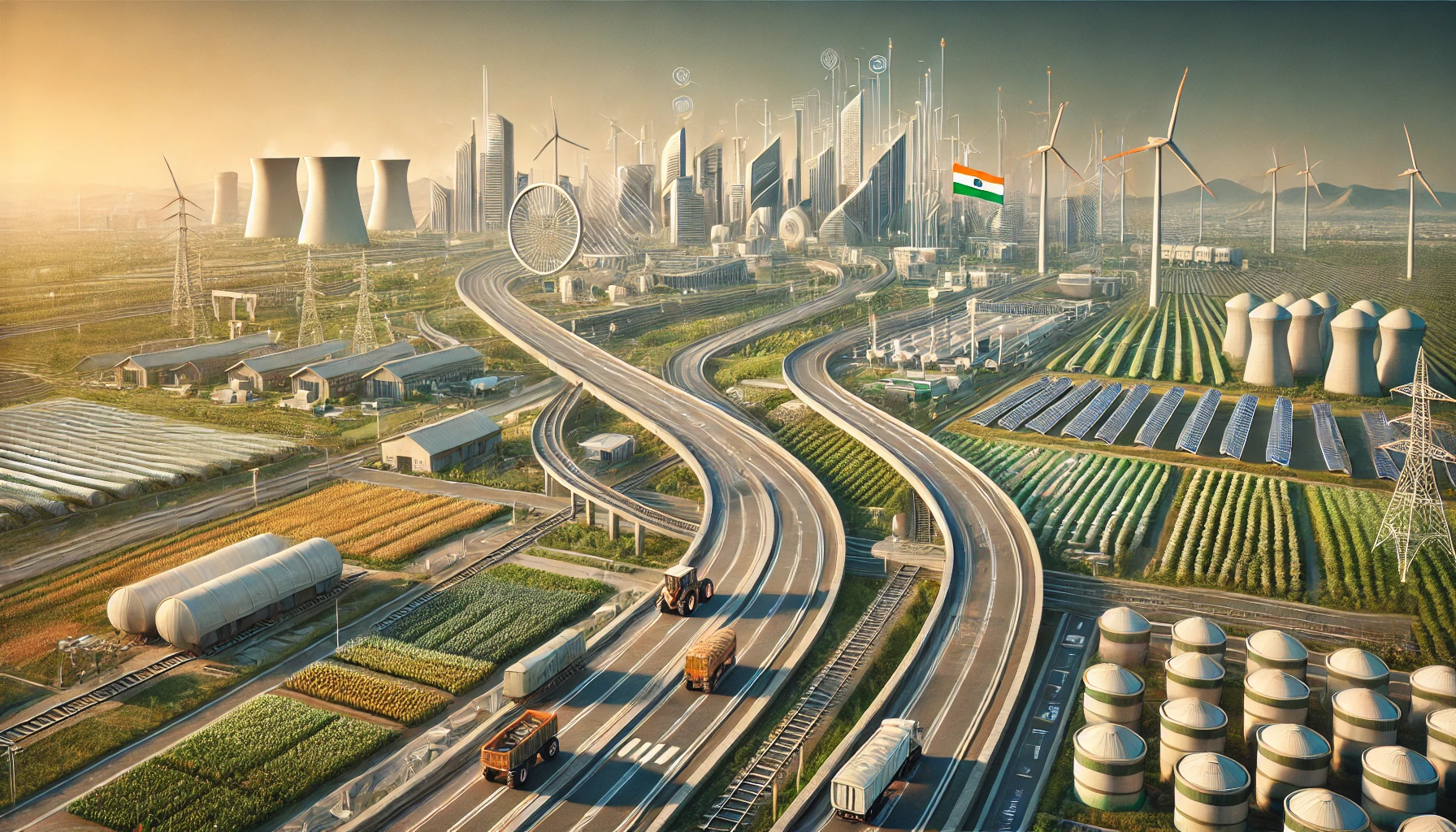
Public investment remains the budget’s defining feature. The continued expansion of capital outlay for infrastructure, logistics, energy, and transport underlines the government’s assessment that private investment will follow only when the state builds the initial foundations. Rail corridors, highways, waterways, and urban infrastructure are presented not merely as construction projects but as instruments of economic integration, intended to reduce transaction costs and connect regions more effectively to markets. This infrastructure-led strategy aligns with the broader objective of positioning India as a competitive manufacturing and export hub. However, the challenge is no longer one of allocation but of absorption. Delays in land acquisition, coordination failures between the Centre and states, and uneven project execution have historically diluted the impact of such spending. The budget’s success will therefore depend less on the headline figures and more on administrative capacity and cooperative federalism.
The budget’s treatment of manufacturing and technology signals a clear strategic intent. Enhanced support for semiconductors, electronics, advanced materials, and green technologies reflects an understanding that economic sovereignty in the twenty-first century will be shaped by control over critical supply chains. Incentives aimed at deepening domestic value addition, alongside efforts to attract global firms to base data, research, and production in India, indicate a desire to move beyond assembly-led growth towards higher technological intensity. At the same time, such industrial policy requires careful calibration. Without transparent criteria, periodic review, and clear exit strategies, incentive regimes risk becoming fiscally costly and economically distortive. The state’s role must remain that of an enabler rather than a permanent guarantor of private profitability.
Agriculture and the rural economy receive a quieter but significant recalibration in this budget. The shift in emphasis from open-ended subsidies towards productivity-enhancing interventions reflects an acknowledgement that income security cannot be sustained without structural change. Investments in irrigation assets, fisheries, horticulture, and digital agriculture platforms indicate an attempt to diversify rural livelihoods and reduce vulnerability to climate and price shocks. Yet the political sensitivity of rural employment remains evident. Changes to employment guarantee frameworks and the increasing reliance on direct benefit transfers will require careful monitoring to ensure that administrative efficiency does not come at the cost of inclusion. In a country where rural distress often manifests with a lag, the absence of visible stress today should not be mistaken for its permanent resolution.
On the social sector, the budget adopts an incremental approach. Education, health, and skill development allocations point towards capacity building rather than expansion of entitlements. New institutions, specialised training programmes, and support for allied health and creative industries suggest an attempt to align human capital development with emerging economic opportunities. This alignment is essential if India’s demographic advantage is to be converted into a productive asset rather than a source of instability. However, outcomes in these sectors depend heavily on state-level implementation and local governance. Without improvements in quality, accountability, and coordination, increased allocations alone will not translate into improved learning or health outcomes.
Tax policy in Budget 2026 reflects an effort to reduce friction rather than alter fundamentals. The proposed overhaul of the income tax framework aims at simplification, predictability, and reduced litigation, addressing long-standing concerns of both individuals and businesses. Stability in corporate taxation signals reassurance to investors that policy reversals are unlikely, while selective changes in transaction taxes and compliance rules indicate a willingness to fine-tune rather than reform radically. This stability is valuable, but it also underscores a broader issue: India’s tax base remains narrow relative to its ambitions. Over time, sustained investment in public goods will require deeper tax compliance, improved enforcement, and a more balanced sharing of the fiscal burden.
From a political economy perspective, the budget avoids overt populism but does not entirely escape political contestation. Critics have argued that its benefits accrue disproportionately to capital-intensive sectors and urban constituencies, while supporters contend that long-term growth is the most durable form of welfare. This debate is not new, but it gains urgency as inequality, employment quality, and regional disparities remain persistent concerns. The budget’s implicit response is that growth-led redistribution, supported by targeted welfare, is preferable to expansive subsidies. Whether this balance is socially and politically sustainable will become clearer as economic conditions evolve.
In sum, Budget 2026 is best understood as an exercise in direction-setting rather than spectacle. It reinforces a trajectory that prioritises infrastructure, manufacturing, and fiscal discipline while seeking gradual improvements in human capital and governance. Its strengths lie in coherence and continuity; its weaknesses lie in the persistent gap between intent and implementation. The budget does not promise quick transformations, nor does it offer dramatic relief. Instead, it places a wager on the state’s ability to execute, coordinate, and sustain reform over time. For a country of India’s scale and complexity, that wager may be both prudent and demanding.