Signals of Instability in Global Financial Markets
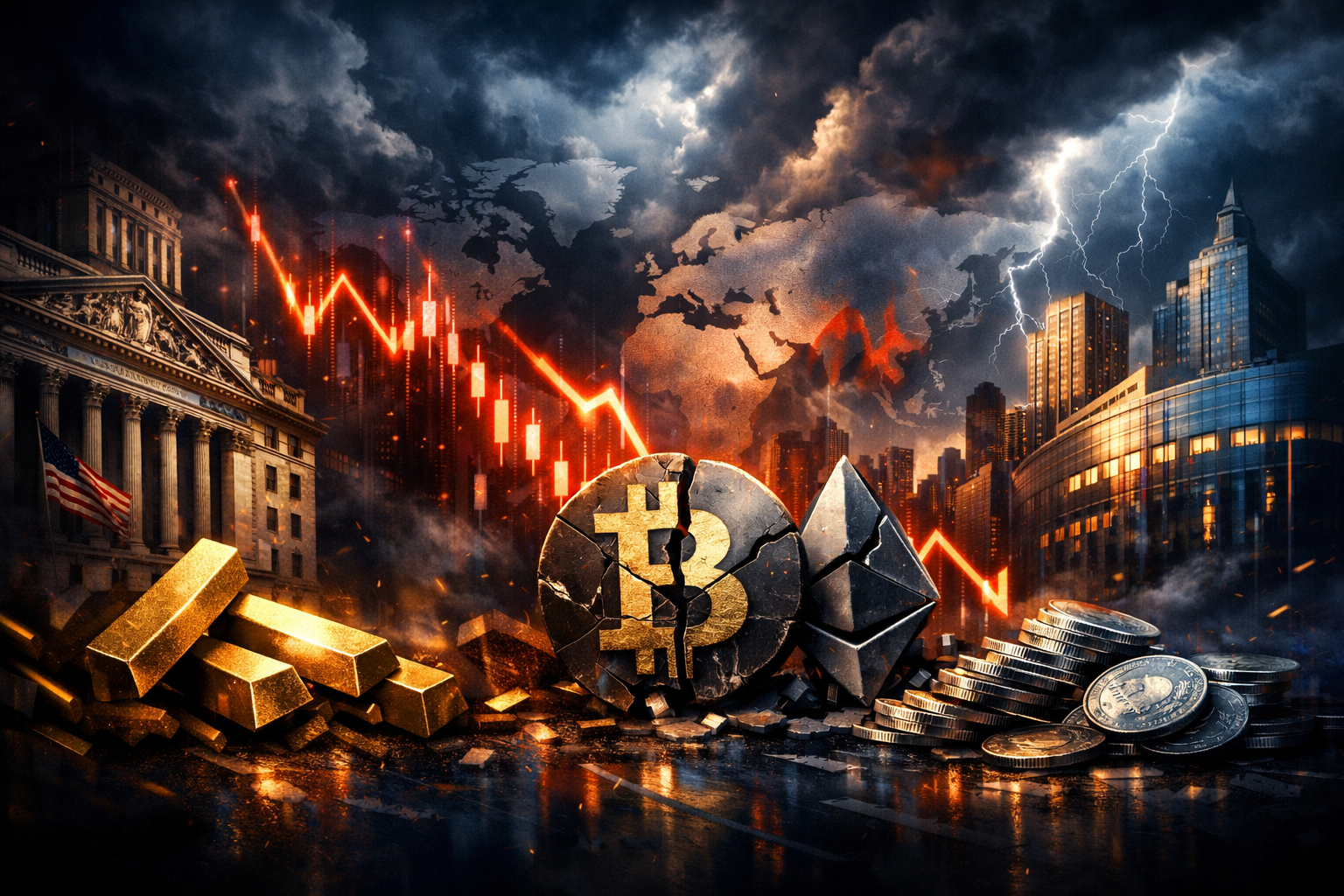
The sharp and simultaneous decline witnessed recently across global financial markets is not merely a routine correction but a reflection of deeper structural unease within the international economic system. Assets traditionally regarded as safe havens—gold, silver, and even digital assets such as cryptocurrencies—coming under pressure at the same time underscores the fragile nature of investor confidence in the present environment. The erosion of nearly three trillion dollars in market value within a short span highlights the extent to which modern markets are driven not only by fundamentals of demand and supply, but also by policy signals, political interventions, and collective psychological responses. Such movements, cutting across asset classes and geographies, reveal how closely interconnected global finance has become.
A frequent question during such episodes is where this “lost” money has gone. In reality, most of this decline represents a contraction in paper valuations rather than a direct transfer of wealth. When asset prices fall, the notional value of portfolios diminishes, creating the impression that capital has been wiped out. The real damage, however, is unevenly distributed. Investors exposed to high leverage, particularly those active in futures and options markets, face the greatest risk, as sudden price movements can rapidly eliminate their capital. Long-term investors with diversified holdings may view such declines as part of a cyclical adjustment, yet when multiple asset classes fall together, it points to a broader climate of uncertainty rather than isolated market-specific factors.
At the centre of the recent turbulence lies growing unease over economic policy in the United States. Given the dominant role of the dollar in global trade and finance, developments in American monetary policy inevitably reverberate worldwide. Concerns surrounding the independence of the Federal Reserve, especially amid political pressure over interest rate decisions, have unsettled markets. Public tension between political leadership and the central bank is interpreted by investors as a threat to institutional stability. The decision to maintain interest rates, contrary to expectations of a cut, acted as a trigger for sharp market reactions. These responses were driven as much by sentiment and fear as by economic calculation, reinforcing how sensitive markets are to perceptions of policy credibility.
The fall in gold and silver prices also draws attention to the speculative excess that had built up earlier. In the absence of strong industrial demand or structural supply constraints, prices had risen rapidly, fuelled largely by investor enthusiasm and expectations rather than fundamentals. When valuations move too far ahead of underlying realities, even a minor adverse signal can prompt widespread profit-taking. The recent correction in silver prices illustrates this pattern clearly. It serves as a reminder that even assets labelled as “safe” are not immune to overvaluation and sudden reversals when sentiment changes.
The parallel decline in cryptocurrencies further challenges the notion that digital assets operate independently of the traditional financial system. Despite being promoted as alternatives to fiat currencies, cryptocurrencies remain closely linked to global liquidity conditions, interest rate expectations, and policy developments. When uncertainty surrounding the dollar and the US economy intensifies, investors may initially view digital assets as hedges. However, in periods of acute ambiguity, the instinct to reduce exposure to risk often prevails, leading to sharp sell-offs even in these markets. This behaviour demonstrates that confidence, rather than novelty or technology, remains the defining factor in asset valuation.
From a policy perspective, the episode reinforces the importance of central bank autonomy. Independence in monetary decision-making is not merely a constitutional principle but a cornerstone of financial stability. When markets perceive that central banks are subject to political influence, trust erodes rapidly, affecting capital flows and exchange rates. Short-term political considerations interfering with monetary policy can result in long-term consequences such as inflationary pressures, currency depreciation, and financial imbalance. This is precisely why mature economies place strong institutional safeguards around their central banks.
For Indian investors and policymakers alike, the developments offer valuable lessons. While domestic markets may not react immediately or proportionately to global shocks, they are not insulated from them. Prudence, diversification, and a clear understanding of risk remain essential. Panic-driven investment decisions—whether rushing into assets during rallies or exiting hastily during downturns—undermine long-term wealth creation. A disciplined approach, grounded in fundamentals and guided by realistic expectations, is better suited to navigating periods of global volatility.
Ultimately, market uncertainty is an enduring feature of modern finance. What distinguishes stability from chaos is the credibility of institutions and the clarity of policy direction. The recent turbulence should therefore be viewed not only as a temporary market correction but as a cautionary signal, emphasising the critical role of institutional independence and coherent economic policy in sustaining long-term financial balance.