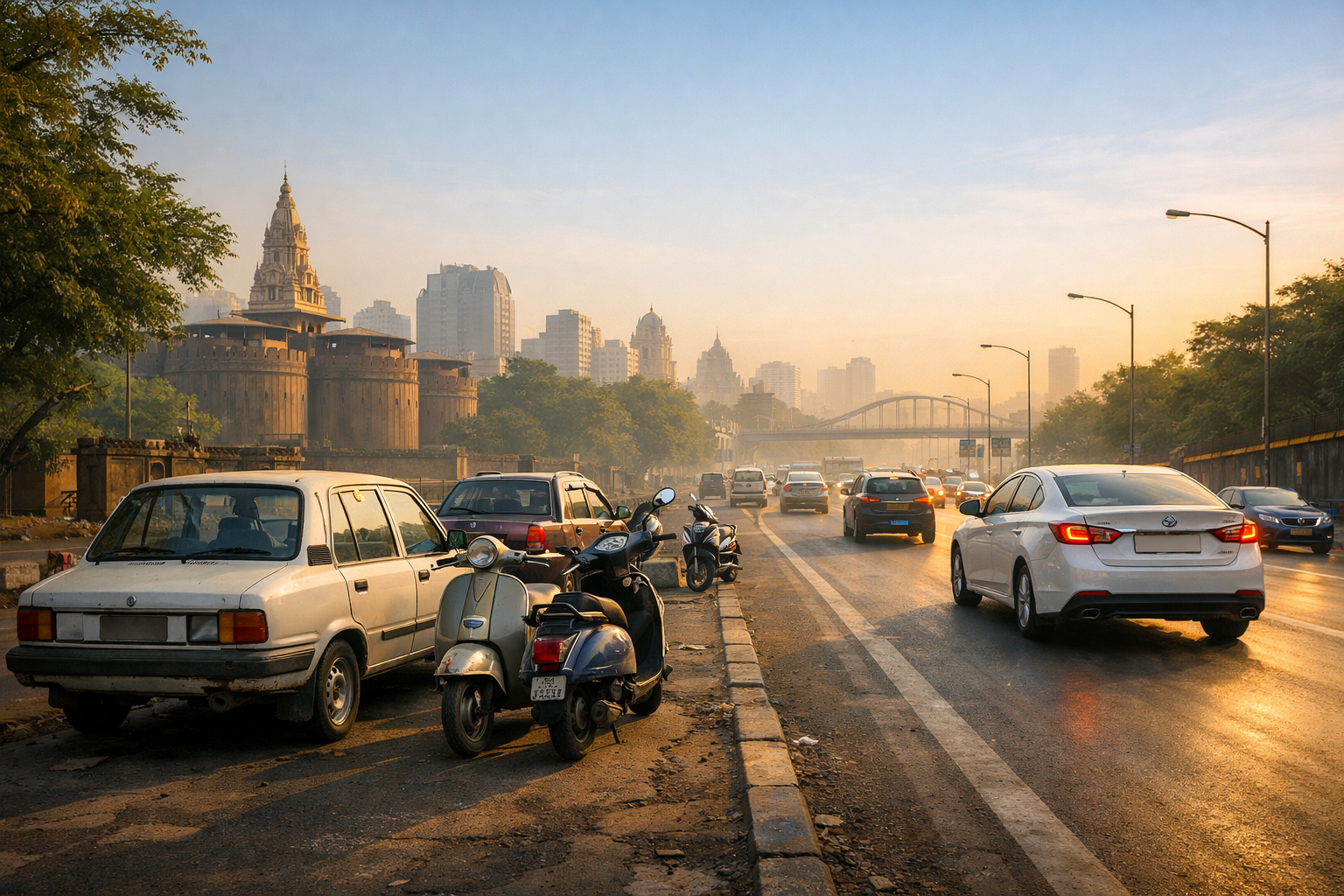
The proposal to prohibit vehicles older than 15 years in Pune, reportedly being forwarded to the state government, has triggered a significant public debate. The stated objective is to reduce traffic congestion and air pollution, and if approved, the measure could result in the scrapping of several lakh vehicles within the city. Environmental protection and urban mobility management are legitimate governance priorities. However, any policy of this magnitude must be evaluated not only on its stated intent but also on its structural logic, social consequences, and administrative consistency. An age-based vehicle ban in Pune raises questions that require careful examination.
The first issue concerns the rationale of using vehicle age as the sole or primary criterion. A regulatory framework already exists in the form of fitness tests and emission checks. If a vehicle is well maintained, complies with prescribed emission standards, and successfully clears official fitness inspections, then prohibiting it solely due to its age appears inconsistent with evidence-based policymaking. Either the fitness certification mechanism is reliable, in which case performance should determine eligibility, or it is unreliable, in which case the integrity of the testing system itself must be addressed. Public policy cannot rest on broad assumptions when measurable technical criteria are available.
A second concern relates to the assumption that scrapping older vehicles will automatically reduce congestion in Pune. The removal of an old vehicle does not imply that its owner will cease commuting. In many cases, individuals will attempt to purchase another vehicle, possibly newer but still adding to the overall fleet size. Therefore, the net reduction in traffic volume is uncertain. Experience from other metropolitan regions where similar age-based restrictions exist indicates that congestion and pollution often persist despite such measures. Urban traffic is influenced by multiple structural factors including road capacity, land use planning, public transport quality, parking regulation, and civic discipline. Addressing only the age of vehicles risks oversimplifying a complex systemic issue.
The third dimension is social equity. Older vehicles are disproportionately used by lower middle-income and economically vulnerable groups. The cost of purchasing a new vehicle, servicing loans, paying insurance, and bearing higher taxes is not uniformly manageable across income categories. If an age-based prohibition is implemented without transitional safeguards, financial incentives, or structured assistance, the burden will fall primarily on those least capable of absorbing it. Environmental policy must not inadvertently intensify economic inequality. Fair burden-sharing is a foundational principle of just governance.
Another question concerns institutional consistency. Will identical standards be applied to government fleets, municipal vehicles, and public transport systems? If public buses operate beyond optimal capacity, or government vehicles remain in visibly poor condition while private owners face strict enforcement, regulatory credibility weakens. The legitimacy of any rule depends on uniform application. Governance that demands compliance from citizens must first demonstrate discipline within its own administrative apparatus. Selective enforcement erodes public trust.
Environmental protection and sustainable urban mobility remain essential public objectives. Yet effective reform requires integrated planning rather than isolated administrative interventions. An age-based vehicle ban in Pune may appear administratively straightforward, but without comprehensive supporting measures—such as strengthening public transport, rationalising parking policy, improving road design, and ensuring credible inspection systems—its long-term impact may be limited. Policy must be guided by empirical assessment, social sensitivity, and institutional coherence. Only then can regulatory action command public confidence and achieve durable outcomes.
Pune Vehicle Ban Policy Debate