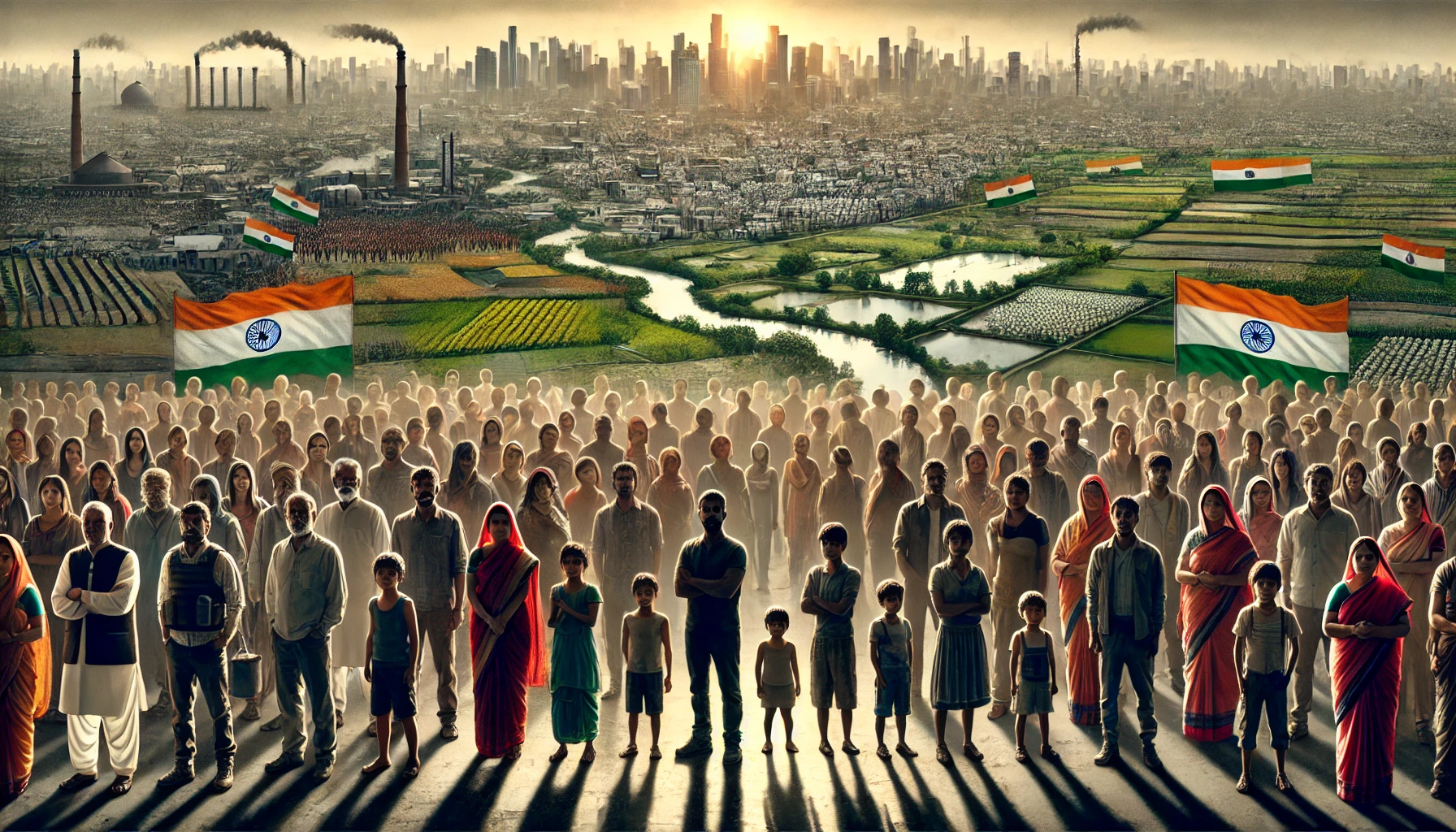
India’s Rising Population and the Governance Test
India’s rising population is not merely a demographic statistic; it is a profound governance challenge with long-term economic, social, and environmental implications. In the decades following Independence, improvements in healthcare, declining mortality rates, and increased life expectancy accelerated population growth. Today, India stands as the most populous country in the world. This reality presents a complex duality. On one hand, a large population offers an expansive workforce, a vast domestic market, and significant human potential. On the other, it places relentless pressure on limited resources, public infrastructure, and the state’s capacity to deliver equitable growth.
Population growth in India cannot be understood solely through birth rates. It is deeply intertwined with structural inequalities in education, health, income, and regional development. While several states have made notable progress towards population stabilisation, others continue to record high fertility rates. This uneven demographic transition creates a distorted national picture, where aggregate figures conceal sharp regional contrasts. Such imbalance complicates fiscal planning, inter-state resource allocation, and the design of effective public policy. It also risks deepening disparities between regions that are demographically mature and those still grappling with rapid population expansion.
The most immediate test of rising population is visible in the labour market. Each year, millions of young Indians enter the working-age group, but the economy has struggled to generate sufficient quality employment. Formal sector job creation has not kept pace with demographic growth, resulting in an expanding informal sector characterised by low wages, insecure work, and minimal social protection. This is not merely an employment issue but a broader challenge to social stability. The education system plays a decisive role here. Expanding access without ensuring quality and relevance limits the employability of the workforce. Without sustained investment in skill development aligned with economic needs, India risks turning its demographic potential into a liability.
Basic services such as healthcare, drinking water, housing, and food security are under increasing strain due to population pressures. Rapid urbanisation has led to overcrowded cities, stretched infrastructure, and growing informal settlements, while many rural areas continue to face gaps in essential services. At the same time, climate change and environmental degradation have exposed the finite nature of natural resources. Land availability, water management, and energy demand are becoming increasingly contentious issues. In this context, unchecked population growth amplifies environmental stress and complicates efforts towards sustainable development.
Policy responses to population challenges require a careful balance. Coercive or narrowly target-driven approaches have historically proven ineffective and socially disruptive. Evidence consistently shows that population stabilisation is most successfully achieved through broader human development measures. Women’s education, access to healthcare, nutritional security, and economic participation have a direct and lasting impact on family size decisions. When households feel secure about health, income, and the future, fertility rates tend to decline naturally. Importantly, population policy must recognise India’s diversity. A uniform national approach cannot address varied regional realities. Decentralised, context-sensitive implementation is essential for meaningful outcomes.
India’s rising population ultimately represents a strategic choice point. With informed planning, inclusive growth, and sustained investment in human capital, it can serve as the foundation of long-term national strength. However, policy complacency, uneven development, and short-term thinking could transform this demographic advantage into a source of economic stress and social tension. Population management, therefore, should not be reduced to periodic debate or political signalling. It must be treated as a core national priority, firmly embedded within India’s broader vision of constitutional values, social equity, and sustainable development.