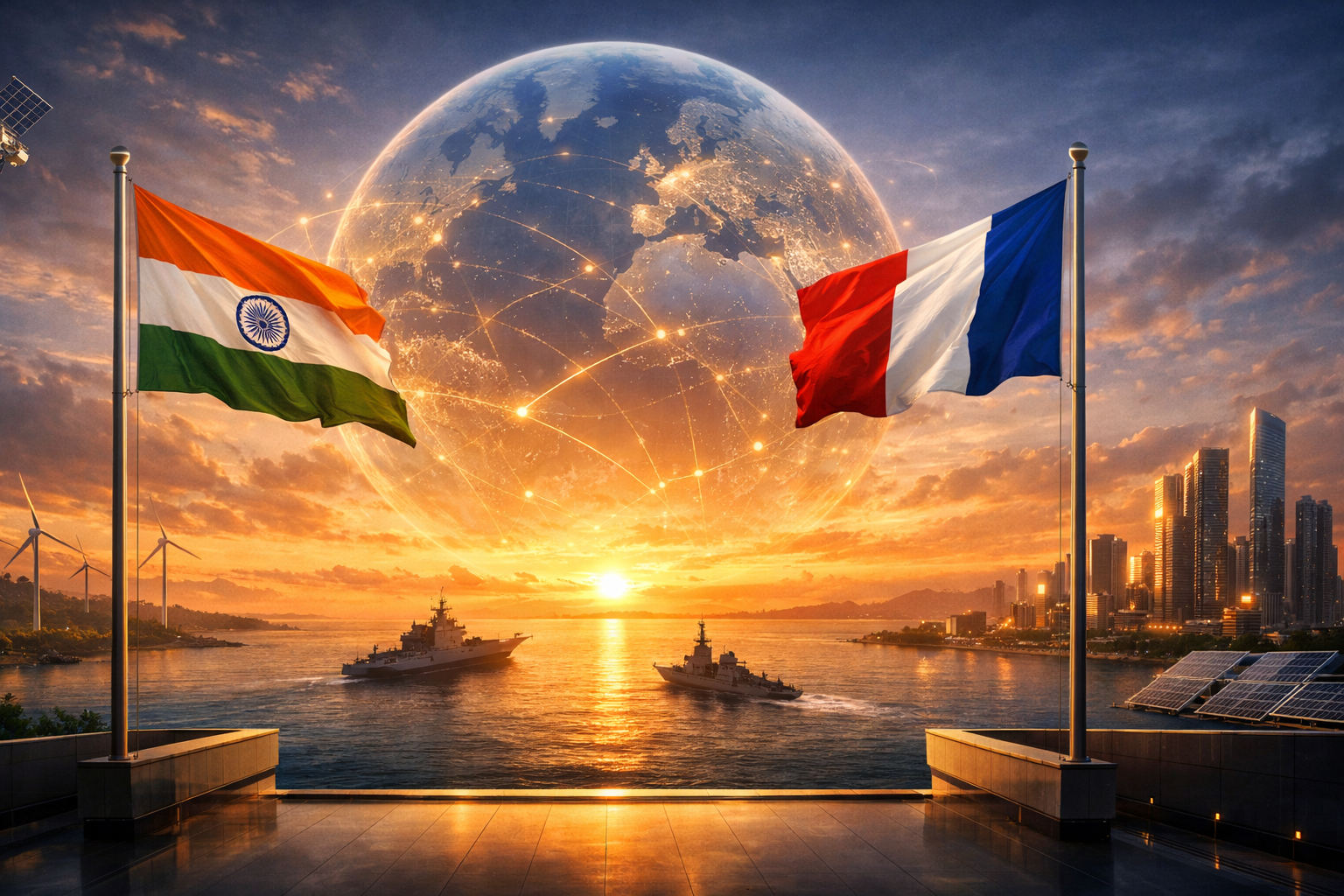
The India–France partnership has steadily evolved beyond ceremonial diplomacy into a substantive strategic relationship shaped by the demands of a changing global order. At a time when the international system is moving away from a rigid bipolar or unipolar structure toward a more fluid multipolar arrangement, the depth and consistency of engagement between New Delhi and Paris assume structural importance. This relationship rests not merely on transactional cooperation but on converging assessments of sovereignty, strategic autonomy, technological capability and institutional balance in global governance. As geopolitical rivalries intensify, supply chains realign and technological dominance becomes a new measure of power, India and France have positioned themselves as partners seeking equilibrium rather than alignment within bloc politics.
One of the most significant dimensions of this partnership lies in the domain of technology and digital sovereignty. Europe has long possessed formidable academic and scientific traditions, yet its technology ecosystem has struggled to match the scale, capital concentration and risk appetite visible in the United States and China. France, in particular, has recognised that innovation alone is insufficient without scale, patient capital and regulatory coherence. Efforts to strengthen artificial intelligence infrastructure, expand data centre capacity and invest in frontier technologies such as quantum computing reflect a broader European attempt to reclaim strategic space in emerging sectors. India’s experience in building digital public infrastructure — creating platforms that expanded financial inclusion, administrative access and digital identity at scale — has attracted global attention. The dialogue between these two models represents more than technological collaboration; it is an exchange of governance philosophies on how innovation can serve inclusion without surrendering regulatory control.
Defence and maritime cooperation constitute another foundational pillar of the partnership. The Indo-Pacific has emerged as a theatre where strategic competition intersects with questions of freedom of navigation, supply chain resilience and regional stability. France, as a resident power in the Indo-Pacific with overseas territories and maritime interests, shares India’s concern regarding secure sea lanes and balanced regional architecture. Joint exercises, defence procurement partnerships and co-development initiatives signal a level of trust rarely seen in bilateral relations. Importantly, this cooperation does not stem from hostility toward any particular power but from a shared commitment to preserving autonomy. Strategic autonomy, in this context, does not imply isolationism; it signifies the ability to engage widely without dependency. Both countries have demonstrated that diversified partnerships enhance, rather than diminish, sovereign decision-making.
Economic engagement further reinforces this structural convergence. Trade, green energy collaboration, civil aviation, space research, urban infrastructure and sustainable development represent areas of mutual complementarity. France offers access to advanced industrial capabilities and European markets, while India provides scale, demographic momentum and expanding technological capacity. As global supply chains diversify and resilience replaces cost efficiency as the primary metric, India’s manufacturing ambitions and France’s industrial expertise could align more closely. However, economic partnership must be grounded in regulatory predictability and transparent frameworks. In an era marked by protectionist tendencies and currency volatility, sustainable cooperation will depend upon institutional clarity rather than episodic agreements.
Beyond economics and security lies a deeper normative alignment. The future of the global order depends not only on material power but also on the preservation of rule-based systems. Recent years have witnessed growing uncertainty regarding multilateral institutions, adherence to international law and respect for territorial integrity. In such an environment, the India–France dialogue reflects a commitment to balancing power politics with principled engagement. Both nations have consistently emphasised multilateral reform, climate responsibility and energy transition. Their cooperation on solar energy initiatives and environmental commitments demonstrates that their partnership extends beyond immediate strategic interests. By advocating reform rather than rejection of global institutions, they position themselves as stakeholders in a stable, law-based international framework.
Education, research collaboration and cultural exchange represent the long-term foundation of this relationship. Strategic partnerships endure only when societal linkages deepen. Expanding academic exchanges, facilitating mobility for researchers and encouraging innovation ecosystems to interact across borders create durable interdependence. France’s emphasis on intellectual tradition, creative industries and scientific excellence finds resonance in India’s expanding knowledge economy. The movement of students, entrepreneurs and researchers between the two countries contributes not merely to economic output but to the cultivation of shared intellectual capital. In a world increasingly defined by technological disruption, human capital remains the decisive resource.
The question of multipolarity often invites simplistic interpretations of shifting alliances. Yet a genuinely multipolar order requires disciplined diplomacy, economic resilience and credible defence capacity. It also demands restraint — an ability to engage competing powers without succumbing to dependency or antagonism. India and France have each articulated the importance of maintaining balanced relations with major powers while strengthening independent capabilities. This approach is not an attempt to dilute existing alliances but to prevent strategic overconcentration. In doing so, both countries reflect an emerging consensus that sovereignty in the twenty-first century must be technologically informed, economically diversified and diplomatically agile.
The durability of the India–France partnership will ultimately depend on its capacity to translate shared principles into measurable outcomes. Infrastructure cooperation must yield visible industrial integration; defence collaboration must evolve toward deeper technological co-production; and educational exchanges must expand beyond symbolic quotas. If these dimensions mature simultaneously, the partnership could serve as a stabilising axis within an unsettled global landscape. Such an axis would not be confrontational, nor would it seek ideological dominance. Instead, it would embody a disciplined pursuit of autonomy within interdependence — a recognition that sovereignty and cooperation are not contradictory but mutually reinforcing.
In the current international climate, characterised by strategic competition, technological fragmentation and institutional uncertainty, the India–France relationship offers a measured template. It illustrates that middle and major powers alike can collaborate without abandoning strategic independence. It suggests that multipolarity need not translate into disorder if anchored in rule-based engagement and economic pragmatism. And it demonstrates that bilateral partnerships, when guided by long-term structural alignment rather than episodic interests, can influence the broader trajectory of global governance.
India–France Partnership in a Multipolar World