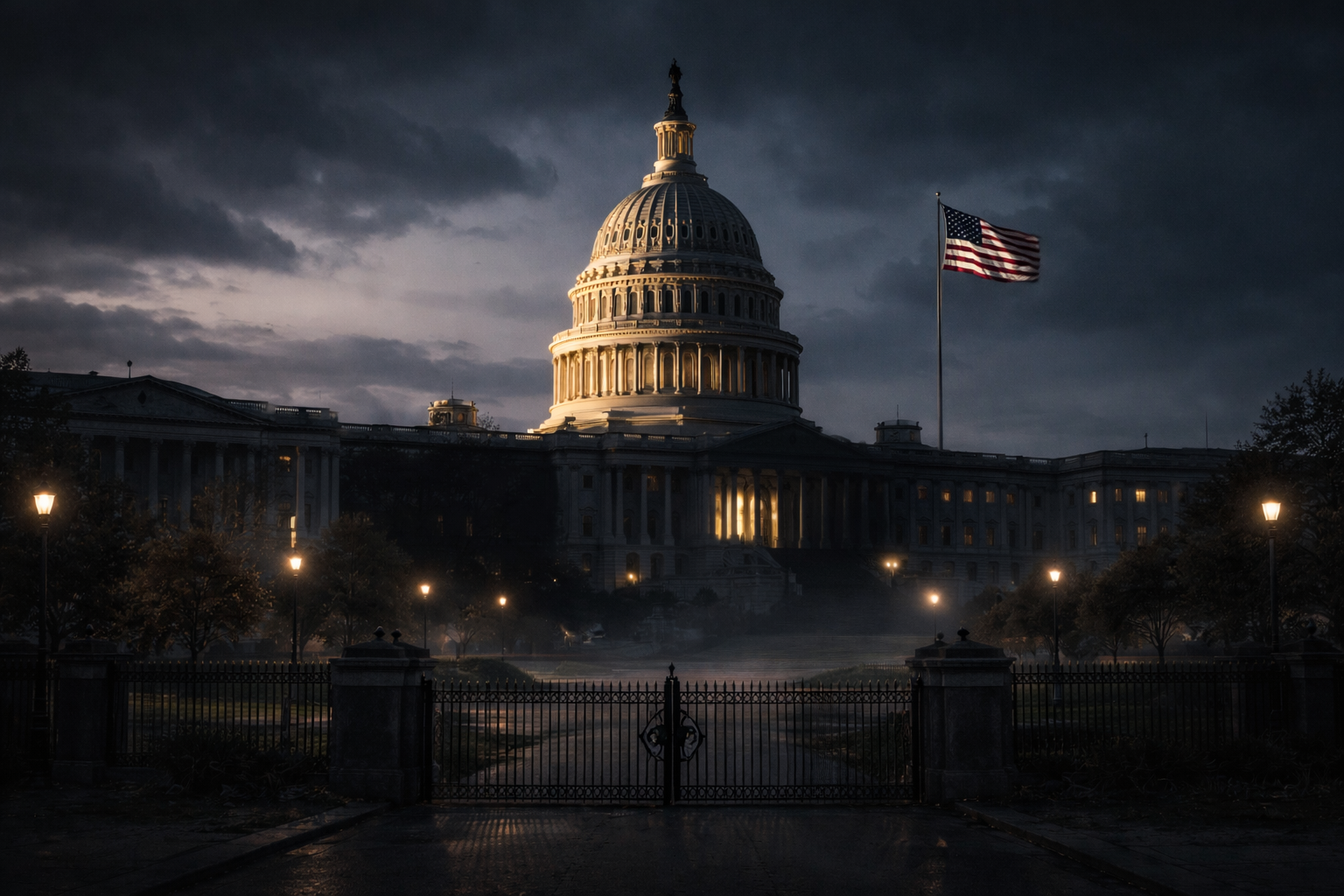
America’s Partial Shutdown and Governance Strain
The onset of a partial government shutdown in the United States once again exposes the fragility that has crept into the country’s fiscal and legislative processes. Funding for much of the federal government lapsed after Congress passed a spending bill that addressed most outstanding budgetary issues but deferred financing for the Department of Homeland Security for two weeks. The delay, rooted in unresolved disputes over immigration policy, has triggered a shutdown affecting non-essential federal services. Although political leaders have signalled that a quick resolution is possible, the episode highlights how routine governance in the world’s largest democracy is increasingly subject to brinkmanship rather than deliberation, and how administrative continuity is repeatedly placed at risk by unresolved political conflict.
At the core of the present impasse lies the budgetary mechanism itself, which has become a recurring arena for partisan confrontation. Instead of serving as a predictable instrument for allocating resources and setting policy priorities, the budget has evolved into a leverage point for forcing concessions on contentious issues. Immigration policy, particularly as it intersects with border security and enforcement, has become one of the most polarising elements in American domestic politics. The decision to postpone funding for the Department of Homeland Security underscores how deeply these disagreements now permeate essential institutions. A department tasked with border management, counter-terrorism, disaster response, and cyber security is left operating under temporary or uncertain arrangements, not because of administrative failure, but because political consensus remains elusive.
The immediate consequences of a partial shutdown are administrative and social rather than ideological. Federal employees designated as non-essential face furloughs or delayed pay, while services considered secondary to core security and health functions are suspended or slowed. Regulatory oversight, environmental monitoring, research programmes, and public-facing administrative offices often bear the brunt of such disruptions. While critical security operations continue, they do so under strain, supported by skeletal staffing and constrained planning horizons. For citizens, the distinction between essential and non-essential services offers little comfort when everyday interactions with the state are interrupted. Over time, these repeated disruptions erode public confidence in the ability of institutions to function independently of political stalemate.
Beyond immediate disruption, partial shutdowns raise deeper questions about institutional resilience and governance norms. Democratic systems are built on the assumption that political disagreement will be managed through debate, compromise, and orderly procedures. When budget deadlines are routinely allowed to lapse, it suggests a weakening of those norms. Temporary funding extensions and short-term fixes may prevent a complete administrative collapse, but they also normalise uncertainty. Agencies struggle to plan, recruit, and invest when their financial footing is unstable. This uncertainty filters down through layers of governance, affecting state cooperation, private contractors, and local administrations that depend on federal clarity and consistency.
The political calculus behind such shutdowns often assumes that public inconvenience will generate pressure for compromise. However, the repeated use of this tactic has dulled its impact while amplifying its costs. Each shutdown, even if partial or brief, reinforces a perception that governance is reactive rather than strategic. Immigration policy, a complex issue involving economic needs, humanitarian obligations, and security concerns, is ill-suited to resolution through fiscal deadlines. Yet it continues to be linked to budget negotiations because it mobilises political bases and sharpens partisan distinctions. This approach prioritises short-term political positioning over long-term policy coherence, leaving structural problems unresolved.
There are also broader implications that extend beyond domestic administration. The United States occupies a central position in global economic and political systems, and its internal governance practices are closely observed. Recurrent shutdowns, even when limited in scope, send signals of unpredictability. Investors, allies, and international institutions value stability and procedural reliability. When the federal government appears unable to guarantee uninterrupted operation of its own departments, questions arise about policy continuity and institutional discipline. While the immediate economic impact of a brief partial shutdown may be modest, the cumulative effect on credibility and confidence is more difficult to measure and potentially more damaging.
Ultimately, the current episode underscores the need for a reassessment of how fiscal governance is conducted in the United States. A swift political agreement to restore full funding may resolve the immediate crisis, but it will not address the underlying pattern that makes such crises recurrent. Budgetary processes must be insulated from policy deadlock to the extent possible, ensuring that essential governance does not become collateral damage in ideological disputes. Immigration reform, like other deeply contested issues, requires sustained legislative engagement rather than episodic confrontation tied to funding deadlines. Without such recalibration, partial shutdowns will remain a recurring feature of American governance, reflecting not administrative necessity but political dysfunction, and steadily undermining the confidence on which democratic institutions depend.