Adoshi Tunnel Gas Tanker Accident
Adoshi Tunnel Gas Tanker Accident and Administrative Failure
The Mumbai–Pune Expressway is widely regarded as the economic lifeline of Maharashtra. It is not merely a high-speed road connecting two major cities, but a critical artery supporting industry, trade, mobility, and regional growth. With projects such as the Atal Setu, the Missing Link, and lane expansions, the expressway has been projected as a symbol of modern infrastructure suited to 2026. Against this backdrop, the gas tanker accident near the Adoshi tunnel and the resulting 32-hour traffic paralysis exposed a starkly different reality. This incident was not an isolated mishap; it revealed deep structural weaknesses in emergency preparedness, administrative coordination, and policy-level planning. Infrastructure proves its strength not during inaugurations, but during crises, and by that measure, the system failed decisively.
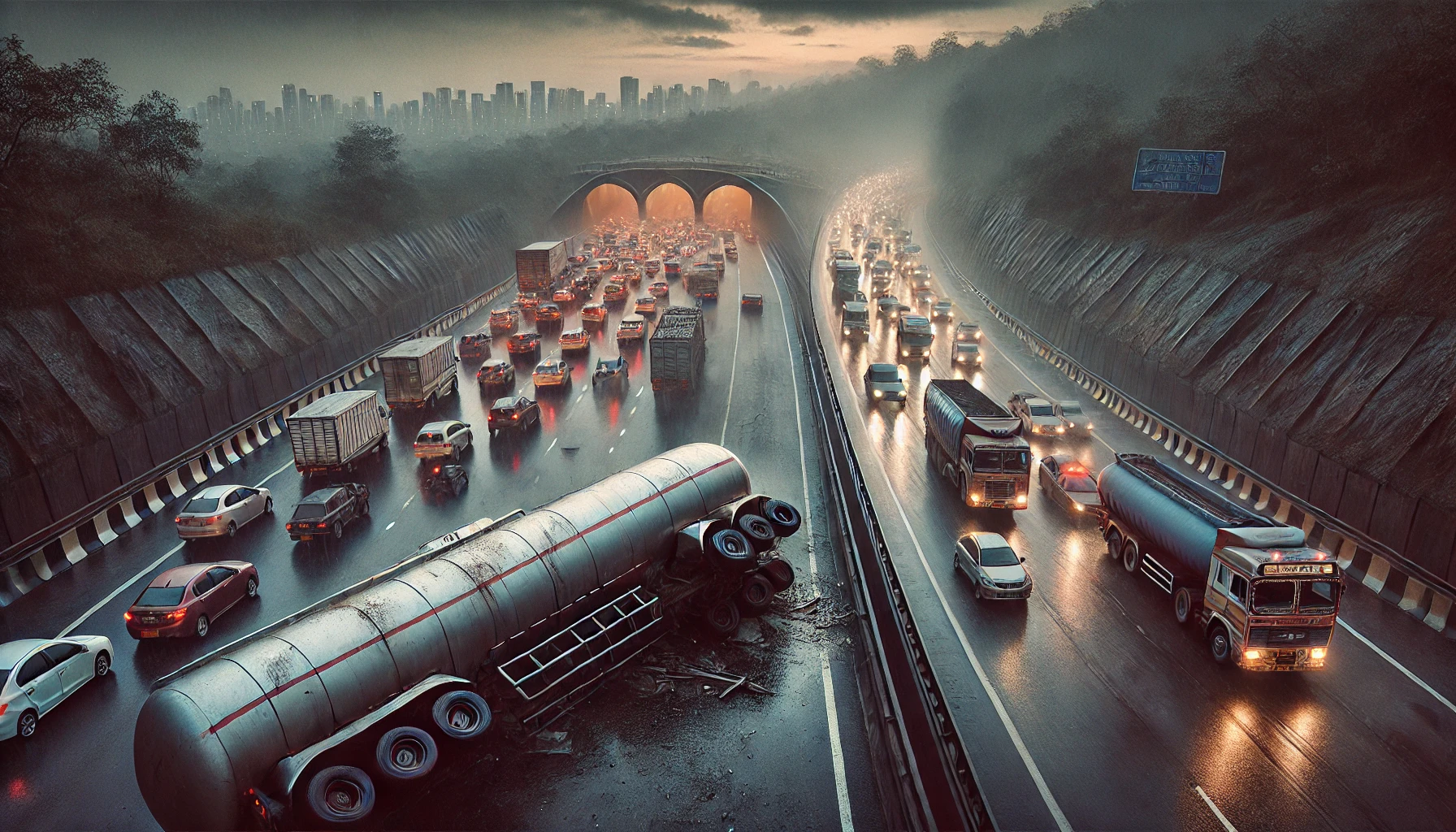
The overturning of a propylene gas tanker on the Adoshi tunnel descent immediately created a high-risk situation. Propylene is an extremely flammable and hazardous gas, and any leakage demands swift, expert intervention. In such incidents, the first few hours are critical. However, there was no immediate deployment of a specialised HAZMAT response team at the site. Traffic on both sides of the expressway was completely halted as a precaution, yet no effective plan existed to divert vehicles or evacuate those already trapped. For the first twelve hours, local agencies and some central forces attempted to manage the situation, but they lacked the industrial expertise required to control a chemical gas leak. The response appeared largely improvised, relying on trial and error rather than established protocols, which is unacceptable in an emergency of this magnitude.
Meaningful control over the gas leak was achieved only after industrial experts were called in, nearly twelve hours after the accident. This delay cannot be explained by technical constraints alone; it reflects clear administrative inertia. During this period, a highly combustible gas continued to pose a threat while thousands of vehicles and passengers remained stranded nearby. Past incidents across the country demonstrate how similar gas leaks have resulted in massive fires and loss of life. Had an explosion occurred inside or near the Adoshi tunnel, the expressway could have turned into the site of a large-scale human disaster. While this incident ultimately became a near-miss, the absence of urgency in learning from it is deeply concerning.
Failures in emergency coordination were evident throughout the episode. The expressway’s design, instead of facilitating disaster response, became an obstacle. Vehicles stuck on both sides left no clear access for rescue and response teams to reach the accident site. Emergency shoulders were either occupied by stalled vehicles or left unmanaged, with no enforcement to keep them clear. Coordination among expressway authorities, highway police, and local administration was visibly weak. There was no effective real-time communication system to update commuters about the evolving situation. In the absence of timely and reliable information, stranded travellers were left confused, anxious, and uncertain about how long the ordeal would last.
Traffic diversion planning was equally inadequate. For nearly fifteen to twenty hours, commuters were held in place before alternative routes were suggested. By then, long queues had formed, making diversion impractical. Advising drivers to take detours of over a hundred kilometres after they had already been trapped for hours demonstrated a disconnect between administrative decisions and ground realities. The reduction of six lanes into two near the accident site created a severe bottleneck. Continuous stop-and-go movement led to overheating engines, clutch failures, and mechanical breakdowns, adding to the congestion. The absence of alternative connecting roads or additional exit points in the Lonavala–Khandala stretch exposed a long-standing planning deficiency that became painfully visible during this crisis.
The human impact of the 32-hour standstill was treated as secondary. Travellers were managed as traffic units rather than as people. Women, children, and elderly passengers remained stuck for extended periods without access to food, drinking water, or sanitation. Ambulances carrying critical patients, including those requiring urgent hospital care, were also trapped in the gridlock. Despite this, there was no organised effort by highway authorities to distribute basic supplies or provide medical assistance. In several places, stranded commuters were forced to buy water and food at inflated prices, turning distress into an opportunity for exploitation. Most strikingly, toll collection continued uninterrupted throughout the crisis. Even as commuters endured extreme hardship, the system prioritised revenue over relief, reflecting a troubling absence of empathy.
The incident raises serious questions about administrative accountability. Political and institutional leadership, quick to claim credit for infrastructure projects during their launch, appeared detached during the crisis. Casual assurances that “work is ongoing” stood in sharp contrast to the severe conditions on the ground. Operating a toll-based expressway system designed for early-2000s traffic volumes under the pressure of present-day demand without adequate upgrades represents a structural failure. Weak lane discipline enforcement, poor regulation of hazardous cargo movement, and inadequate emergency planning together created a situation where collapse was not accidental, but predictable.
The Adoshi tunnel accident should be treated as a clear warning. Infrastructure built without accountability and preparedness becomes a liability rather than an asset. Mandatory suspension of toll collection during prolonged traffic shutdowns, permanently stationed emergency response and HAZMAT teams, reliable real-time alert systems for commuters, and basic humanitarian facilities along major highways are not optional reforms but essential safeguards. Hazardous material transport must be strictly regulated through time windows and dedicated lanes, with severe penalties for violations. If this incident is dismissed as an exception rather than recognised as a systemic failure, the next crisis may not end as a near-miss. It could instead escalate into a full-scale human catastrophe, for which the warning signs have already been made painfully clear.